
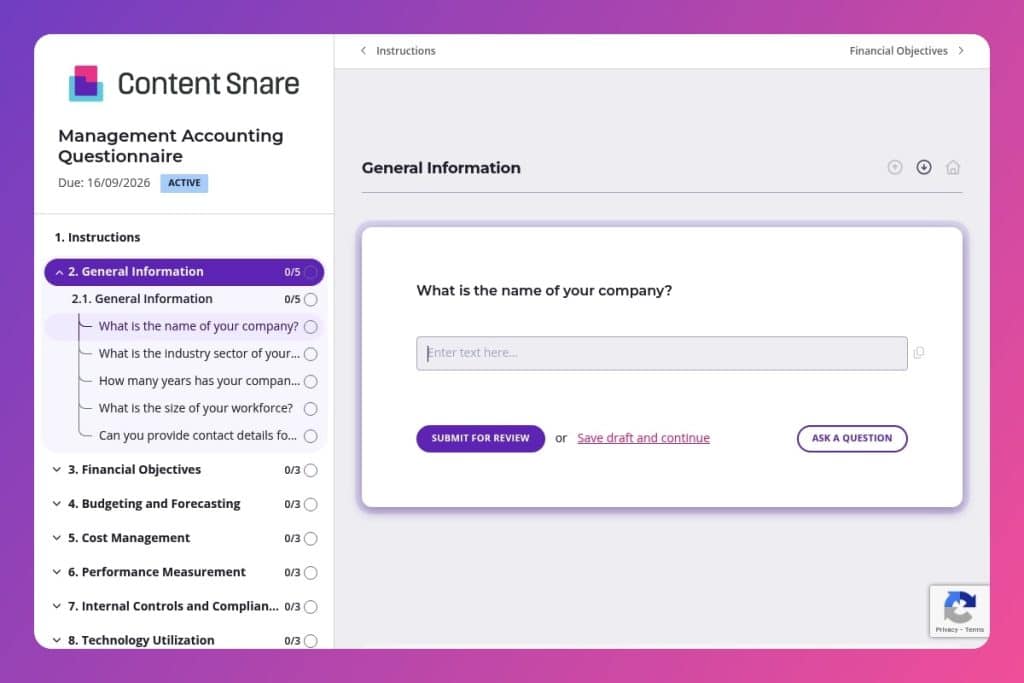


A comprehensive intake questionnaire that collects essential financial management information across budgeting, forecasting, cost control, KPIs, cash flow, and risk management processes.

Management accountants, financial consultants, and accounting firms who need to assess a client's current financial practices, identify process gaps, and establish a baseline before delivering advisory services.

At the start of a new client engagement or during annual strategic reviews to understand their financial infrastructure, pinpoint improvement opportunities, and create a prioritized action plan for ongoing support.
Your management accounting processes could be costing you more than you think. Fragmented budgets, inconsistent KPI tracking, and incomplete financial data create blind spots that lead to missed targets and reactive decision-making. Without a structured approach to gathering critical financial information, accountants waste hours chasing down budget owners, clarifying cost classifications, and piecing together performance metrics.
A management accounting questionnaire solves this problem by standardizing how you collect essential financial insights - from budgeting cycles and variance analysis to cash flow forecasting and risk mitigation strategies. This post covers what makes an effective questionnaire, practical tips for implementation across your organization, and a free template you can customize immediately. Let's dive in.
General Information
Use these items to anchor the file and route follow-ups to the right contact.
Financial Objectives
Confirm priorities to frame analysis and reporting.
Budgeting and Forecasting
Establish planning cadence and rigor.
Cost Management
Map cost structure and current controls to identify quick wins and constraints.
Performance Measurement
Clarify how results are tracked, reviewed, and cascaded.
Internal Controls and Compliance
Gauge control environment and compliance posture.
Technology Utilization
Understand the stack, constraints, and change plans.
Reporting and Analytics
Set expectations for frequency, formats, and decision support.
Cash Flow Management
Surface liquidity practices and pressure points.
Investment and Financing
Capture capital allocation approach and funding posture.
Risk Management
Profile the risk framework and upcoming exposures.
Pre-populate what you already know: Fill in basic company information, current software systems, and existing KPIs before sending the questionnaire to your client. This reduces their workload and shows you've done your homework. They'll focus energy on the strategic questions - like financial challenges and cost reduction opportunities - rather than administrative details.
Frame the budgeting and forecasting section as a conversation starter: Use responses about budget cycles, forecast frequency, and variance analysis approaches to identify gaps in their current process. If a client updates forecasts quarterly but faces monthly cash flow issues, that's your opening to recommend more frequent scenario planning. The questionnaire reveals not just what they do, but where you can add immediate value.
Create a follow-up action plan from their answers: After submission, categorize responses by urgency and impact. Flag areas where they lack formal processes (no variance analysis method, undefined cost classifications) or face specific pain points (seasonal cash flow challenges, emerging financial risks). Schedule your first working session around the two or three highest-priority issues their answers revealed.
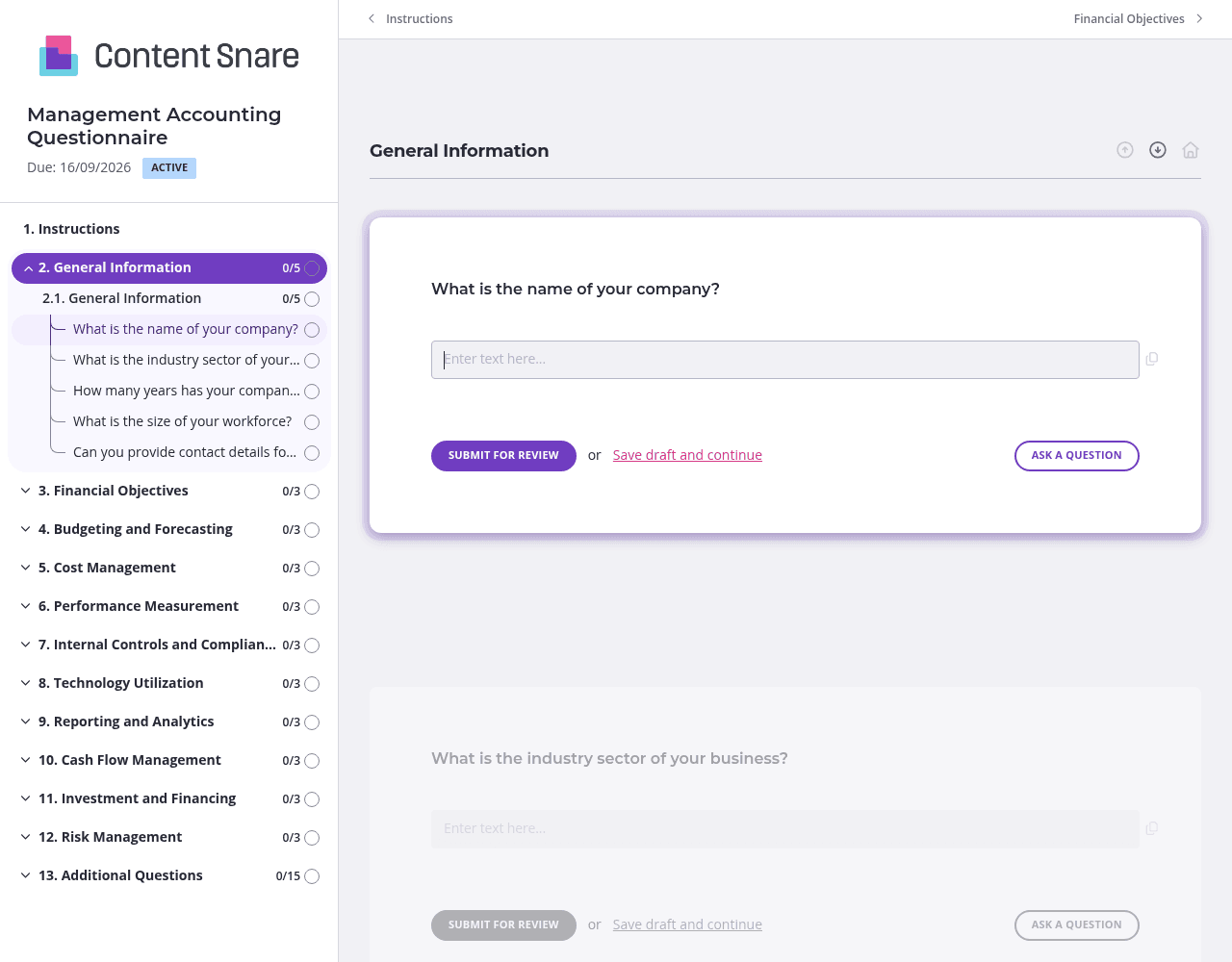
Management accounting covers a lot of ground - from budgeting and KPIs to risk management and cash flow forecasting. Group related questions into clear sections like "Cost Management," "Performance Measurement," and "Cash Flow Management." Your clients can tackle one area at a time rather than facing a wall of financial questions. They'll provide more thoughtful answers when they can focus on budgeting today and move to compliance tomorrow.
Financial terminology means different things to different people. Add brief instructions above sections that might cause confusion. Explain what you mean by "variance analysis" in the budgeting section, or clarify the difference between fixed and variable costs you're looking for. A quick example or definition prevents back-and-forth clarification emails and ensures you get usable data the first time.
Your clients juggle month-end closes, board reports, and audit requests. They'll forget about your questionnaire without malicious intent - they're simply underwater. Automatic reminders keep the process moving without you playing the role of nag. Schedule a gentle nudge at three days, then another at seven. The system handles persistence while you maintain the relationship.
Not every client needs every question. A three-person startup doesn't have the same internal audit schedule as a multinational corporation. Delete questions about workforce size categorization or complex compliance frameworks when they don't apply. Your client sees a questionnaire tailored to their reality, not a generic form they need to navigate around.
Email threads and spreadsheets create chaos when gathering financial data from clients. Questions get buried, version control becomes a nightmare, and you waste hours chasing incomplete information. Content Snare centralizes the entire process in one secure, professional platform that your clients actually enjoy using. Automatic reminders, progress tracking, and structured workflows mean you collect complete, accurate data without the constant follow-up.
Accounting firms trust Content Snare because it's ISO 27001 certified and built to handle sensitive financial information. Thousands of businesses worldwide use it to streamline client onboarding and data collection. The platform integrates seamlessly with tools you already use, and it's earned hundreds of 5-star reviews across G2, Capterra, and the Xero App Store.
This management accounting questionnaire is just one application. Accounting professionals use Content Snare for:
The customization options mean you build the exact workflow your firm needs, then reuse it across every client.


