
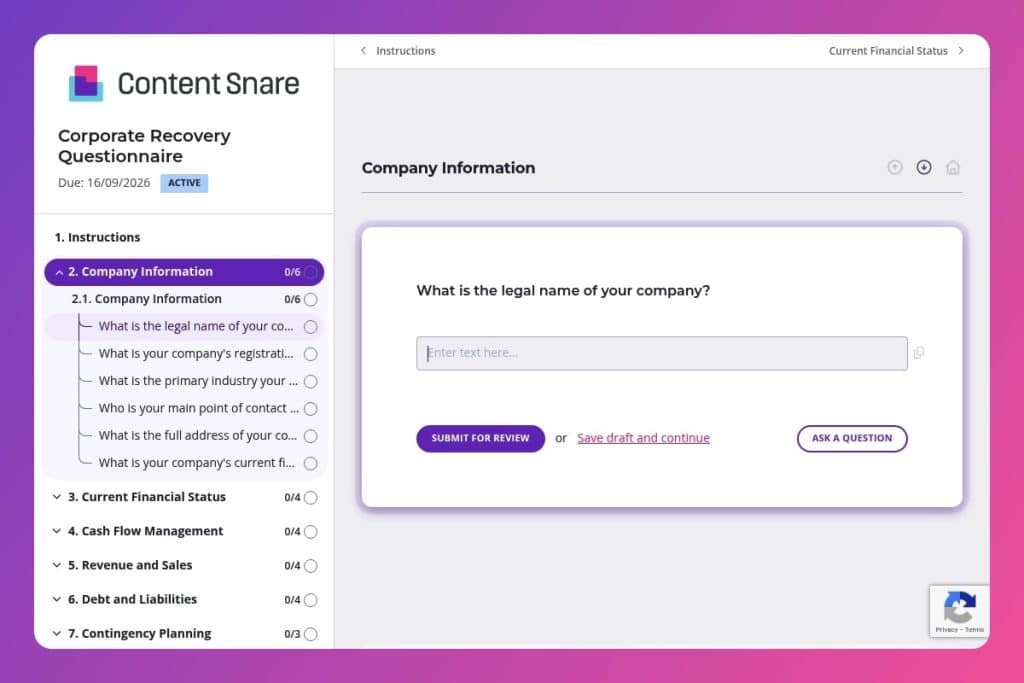


A comprehensive intake form that gathers a distressed company's financial position, cash flow, debt obligations, operational challenges, and recovery goals before you start building a turnaround strategy.

Accountants, insolvency practitioners, and financial advisors working with companies facing cash flow problems, mounting debt, or potential insolvency who need complete financial data to recommend recovery options.

Send it 48-72 hours before your initial consultation with a distressed client so they can gather financial documents and you can walk into the meeting with a complete diagnostic picture instead of chasing information afterward.
Your client is drowning in debt, bleeding cash, and can't answer basic questions about their financial position. You need a complete picture - fast - to recommend the right recovery strategy. But chasing down critical information through endless emails and phone calls wastes billable hours and delays the turnaround plan.
A corporate recovery questionnaire solves this. It captures everything you need upfront: current financial status, cash flow patterns, debt obligations, operational challenges, and recovery goals. This post covers what the form should include, how to use it effectively with distressed clients, and gives you a free template to customize. Let's dive in.
Company Information
Capture core identifiers and reporting cadence to anchor the engagement and route communications.
Current Financial Status
Establish a point-in-time view of solvency and recent governance shifts.
Cash Flow Management
Surface liquidity health, timing of cash movements, and near-term pressures.
Revenue and Sales
Map revenue composition, volume, and payment behavior to gauge durability.
Debt and Liabilities
Detail capital structure, creditor landscape, and key terms.
Contingency Planning
Assess preparedness for shocks and prior crisis handling.
Business Continuity
Document resilience measures, efficiency plays, and people plans.
Operational Metrics
Track performance signals and constraints impacting throughput and margins.
Legal and Compliance
Identify legal overhangs and regulatory posture that could constrain options.
Challenges and Opportunities
Elicit candid views on headwinds, growth angles, and planned investments.
Additional Information
Leave space for scope, objectives, and support requirements.
Send it before the first meeting: Get the corporate recovery questionnaire to your client 48–72 hours before your initial consultation. This gives them time to gather financial documents, consult with their CFO or bookkeeper, and provide accurate data - especially for complex sections like cash flow management and debt obligations. You'll walk into that meeting prepared, not playing catch-up.
Flag the documents you'll need upfront: In your cover email, explicitly list the supporting documents that correspond to form questions: recent balance sheets, income statements, loan agreements, and creditor lists. Clients often overlook attachments, and you don't want to chase down a profit and loss statement three days later when you're trying to build a recovery model.
Use it to spot red flags early: Pay close attention to answers in the Debt and Liabilities and Cash Flow Management sections. Vague responses, missing creditor details, or unrealistic revenue projections signal either poor record-keeping or avoidance - both of which complicate recovery. Follow up immediately on anything incomplete or inconsistent.
Turn it into a diagnostic conversation: Don't just file away the responses. Use the questionnaire as your agenda for the discovery call. Walk through their answers to Challenges and Opportunities together, probe their contingency planning gaps, and clarify ambiguous financial metrics. The form structures the conversation so nothing critical gets missed.
Create a baseline for progress tracking: Save the initial responses and revisit them at 30, 60, and 90-day intervals during the recovery process. Compare updated cash flow data, debt renegotiation outcomes, and operational improvements against their original answers. It's proof of progress for anxious clients and justifies your fees with tangible results.
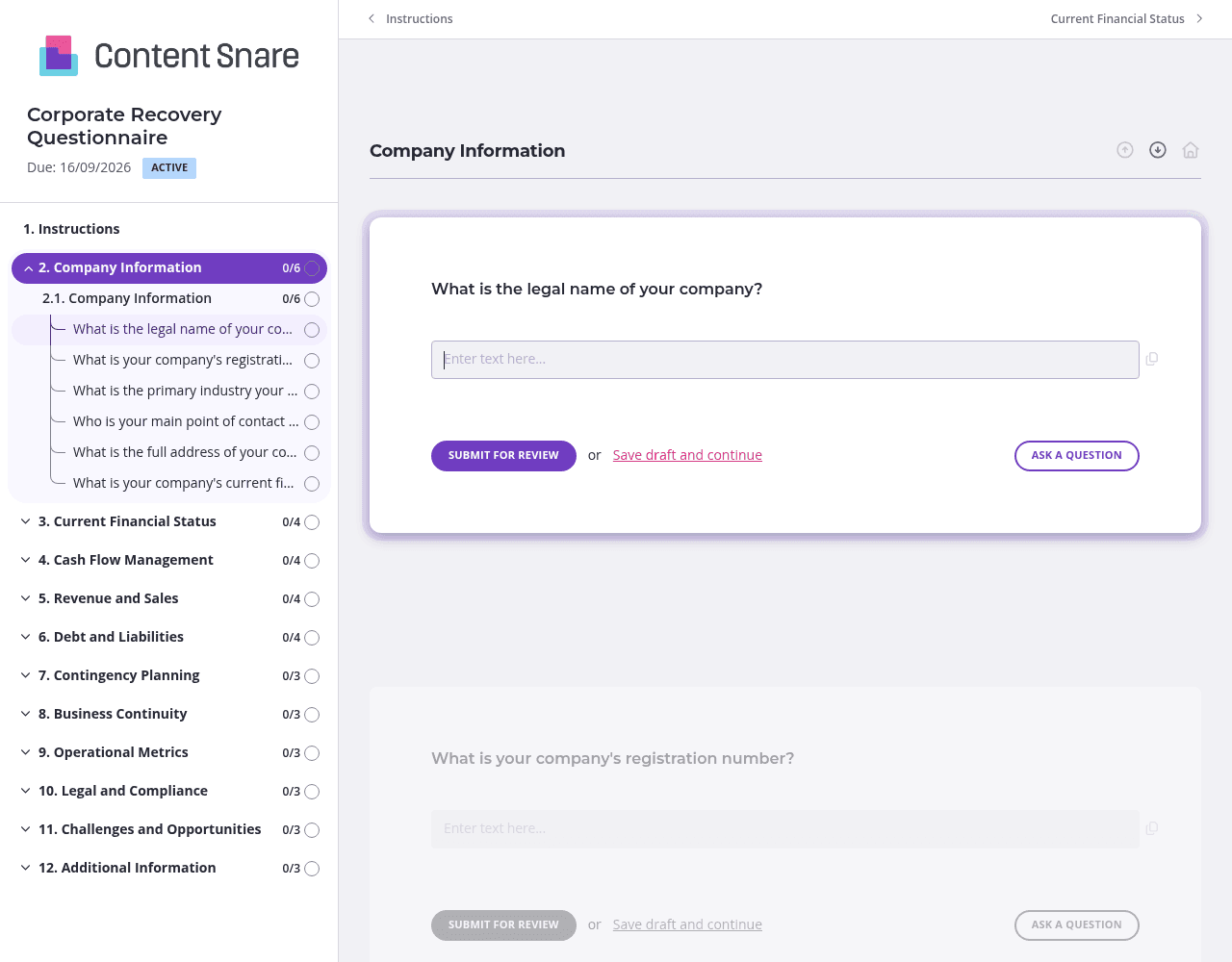
A corporate recovery questionnaire covers a lot of ground - financial status, cash flow, debt obligations, operational metrics, legal compliance. That's overwhelming in one long scroll.
Split the form into logical pages: Company Information, Financial Status, Cash Flow & Revenue, Debt & Liabilities, and Recovery Planning. Your clients can tackle one section at a time, save their progress, and return when they've gathered the next batch of documents. You'll get more complete responses and fewer "I'll finish this later" abandonments.
Questions about debt agreements, creditor terms, and cash flow projections often generate vague or incorrect answers. Clients don't always know what level of detail you need.
Drop clear instructions directly above tricky sections. For "What are the details of any loans your company has taken?" - specify you need lender names, original amounts, current balances, interest rates, and maturity dates. For balance sheets and income statements, note the acceptable file formats and date ranges. A few sentences upfront prevent back-and-forth clarification emails later.
You likely have basic client information on file: legal name, registration number, headquarters address, primary contact details, and reporting cycles.
Pre-populate those fields before sending the form. It saves your client time, shows you've done your homework, and lets them focus on the complex financial data you actually need. Delete irrelevant questions entirely - if you already know their industry or ownership structure, don't make them re-enter it.
Corporate recovery work operates on tight timelines. Creditors don't wait, and neither should your data collection.
Configure automatic follow-ups at 2 days, 5 days, and 7 days for incomplete submissions. The reminders come from you, but you're not manually tracking who's responded or crafting "just checking in" emails. Your client gets a gentle nudge, you get the financial data you need to build their recovery plan, and nobody wastes time on reminder logistics.
Email threads lose attachments. Shared spreadsheets get overwritten. Word documents come back half-finished with no context about what's missing. Content Snare replaces that chaos with a purpose-built system that tracks exactly what you've received, what's outstanding, and automatically follows up until everything's submitted.
**Thousands of accounting firms worldwide **use Content Snare to collect client information without the back-and-forth. It's ISO 27001 certified, so sensitive financial data stays secure - critical when you're handling balance sheets, creditor lists, and loan agreements for distressed companies.
The platform integrates with the tools you already use, from practice management software to cloud storage. You're not adding another disconnected system to your workflow.
Content Snare isn't just for corporate recovery questionnaires. Accounting professionals use it to streamline:
The same features that make corporate recovery intake efficient - automatic reminders, progress tracking, clear instructions, secure file uploads - work across every client information collection scenario in your practice.


