
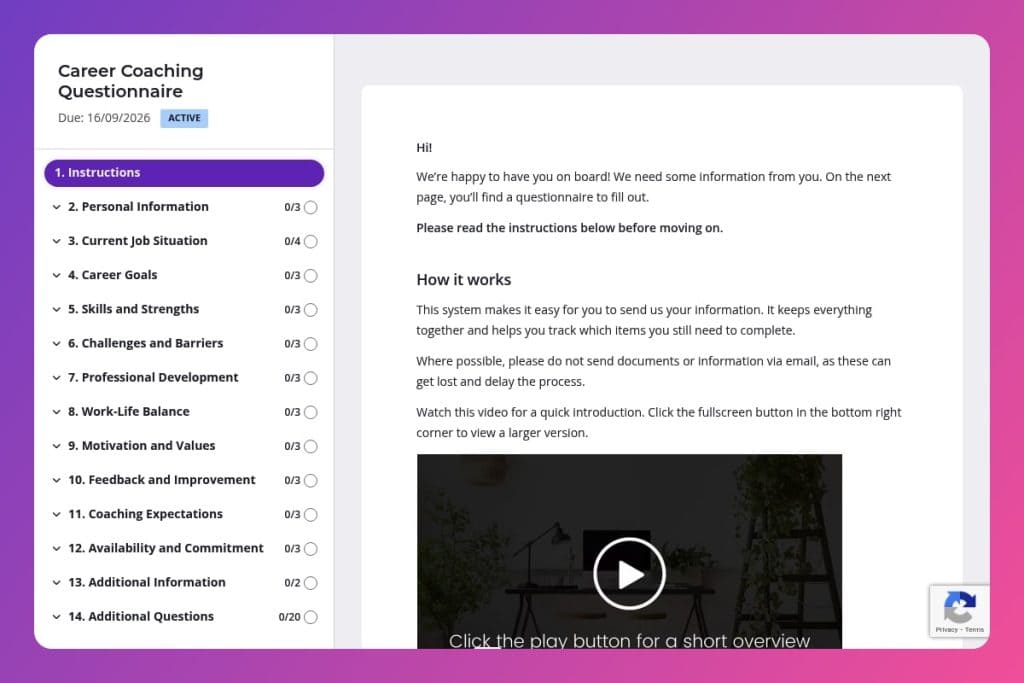


A pre-session intake form that collects information about a client's current job situation, career goals, skills, challenges, work-life balance, and coaching expectations before your first meeting.

Career coaches and professional development consultants who want to maximize session effectiveness by gathering client background, motivations, and obstacles ahead of time.

Send this 48 hours before the initial coaching session so clients can provide thoughtful responses and you can review their situation, identify goal misalignments, and prepare a focused agenda.
Your first coaching session shouldn't feel like pulling teeth. Most coaches spend 30+ minutes just gathering basic information - current role, goals, obstacles, what success actually looks like for the client. That's time you could spend solving real problems.
A career coaching questionnaire changes the game. Send it before your first session and you'll arrive prepared, skip the awkward small talk, and dive straight into meaningful work. This post covers what to include in your form, how to use client responses effectively, and a free template you can customize. Let's break it down.
Personal Information
Capture client identifiers and communication preferences to keep records clean and outreach efficient.
Current Job Situation
Establish current role, tenure, and engagement drivers to anchor coaching scope.
Career Goals
Define direction and target roles to align the coaching plan and benchmarks.
Skills and Strengths
Map perceived strengths and desired upskilling areas to shape development priorities.
Challenges and Barriers
Surface constraints and risk factors that could slow progress.
Professional Development
Assess learning habits and credential plans to align resources and timelines.
Work-Life Balance
Gauge capacity and boundaries that affect goal pacing and strategy.
Motivation and Values
Identify intrinsic drivers and values to guide role fit and decision criteria.
Feedback and Improvement
Calibrate feedback preferences and openness to tailor coaching delivery.
Coaching Expectations
Clarify intent, outcomes, and focus areas to set a shared agenda.
Availability and Commitment
Set cadence, channels, and commitment expectations to manage the engagement.
Additional Information
Leave space for context that structured items may miss.
Send it a few days before your first session: This gives clients enough time to reflect on deeper questions about their motivations, values, and career barriers without rushing. You'll get more thoughtful answers to sections like "Challenges and Barriers" and "Motivation and Values" - questions that require real introspection, not quick responses.
Flag contradictions between their goals and current situation: When reviewing responses, look for misalignments. If someone says work-life balance is their top priority but wants a C-suite role in two years, that's your opening conversation. Similarly, if their strongest skills don't match their target industry, you've identified a concrete development plan before you even meet.
Create a one-page summary from their responses: Pull key quotes directly from the form - their biggest challenge, primary motivation, and top goal. Reference this document throughout your coaching engagement to track progress and keep sessions focused. Clients appreciate seeing their own words reflected back, and it proves you're listening.
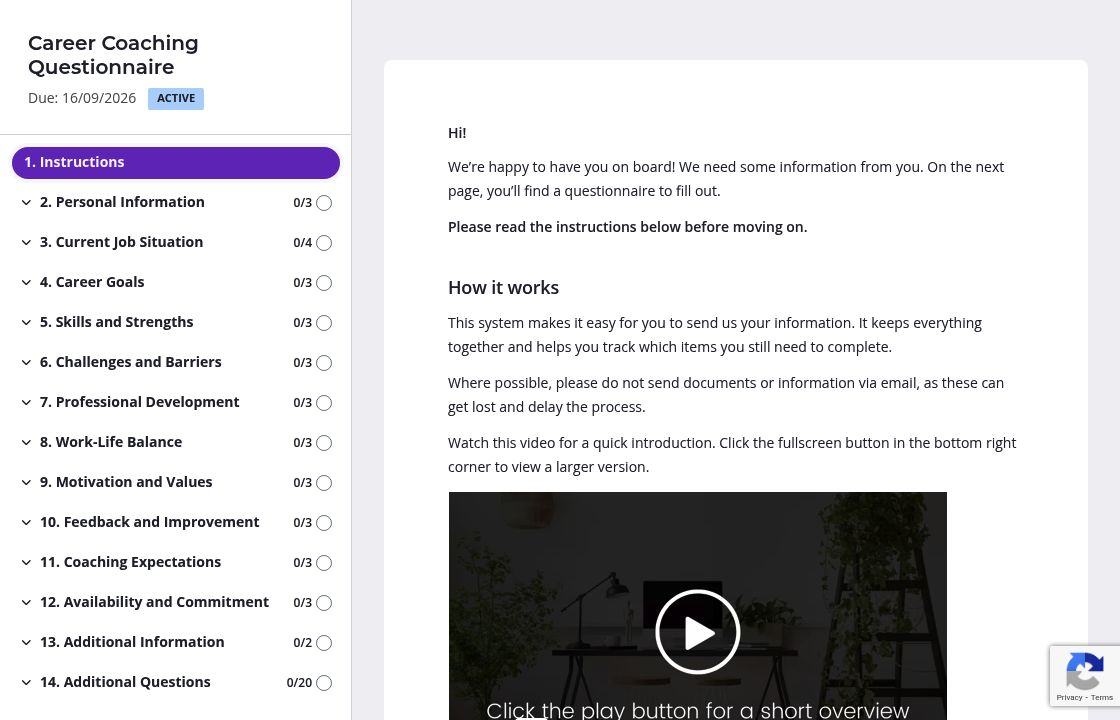
Career coaching questionnaires can feel overwhelming when clients see 30+ questions at once. Content Snare lets you split your form into sections - Personal Information, Career Goals, Skills and Strengths, Work-Life Balance, and so on. Clients answer one page at a time, save their progress, and come back later. The result? Higher completion rates and less abandonment halfway through.
Questions about career barriers or personal values can confuse clients if they're not sure what you're looking for. Drop instruction boxes above tricky sections to clarify. For "What obstacles do you feel are hindering your career progression?", add a quick note: "Think about internal factors (confidence, skills gaps) and external ones (company culture, lack of opportunities)." Clients give you better answers, and you spend less time asking follow-up questions.
You sent the questionnaire three days ago. Crickets. Now you're stuck deciding whether to nudge them or wait longer. Content Snare handles this for you. Set up automatic reminders that go out after a certain number of days - friendly emails that encourage clients to complete the form without you playing the bad guy. Most coaches see submissions within 48 hours of the first reminder.
Not every client needs every question. Someone exploring a career change doesn't need to answer detailed questions about their current role satisfaction. Content Snare's conditional logic shows or hides questions based on previous answers. Ask "Are you currently employed?" first, then display the entire "Current Job Situation" section only if they say yes. Clients appreciate the personalized experience, and you get cleaner data.
Email chains and Google Forms fall apart fast. Clients forget to respond, answers get buried in threads, and you're left manually chasing people down. Content Snare keeps everything organized in one place, sends automatic reminders, and gives you a professional client experience from start to finish. It's trusted by thousands of businesses worldwide and has hundreds of 5-star reviews across G2, Capterra, and Trustpilot.
Security matters when clients share sensitive career information. Content Snare is ISO 27001 certified, so you can collect details about job struggles, salary expectations, and workplace challenges without worrying about data breaches.
Besides that, this career coaching questionnaire is just one way to use Content Snare. Coaches also use it to collect client intake forms, gather pre-session reflections, request testimonials and case study information, and onboard new clients with welcome packets and agreements. You can customize every form to match your process.


