
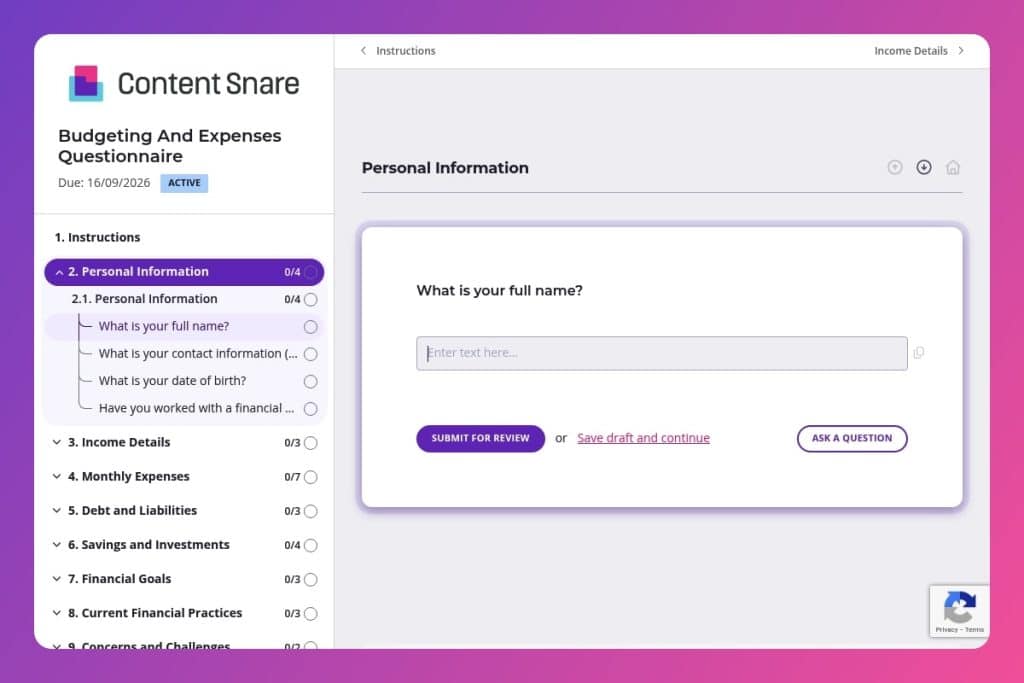


A comprehensive intake form that captures a client's complete financial picture - income sources, monthly spending across all categories, debts, savings habits, and short- and long-term goals.

Financial planners who need accurate baseline data from new clients before building personalized strategies, eliminating guesswork and reducing time spent chasing missing information.

Send this 3-5 days before initial consultations so clients can gather documentation and provide detailed responses, ensuring your first meeting focuses on strategy instead of data collection.
How many of your new clients genuinely know where their money goes each month? Most arrive with rough estimates, forgotten subscriptions, and blind spots that derail even the best financial plans. Without a complete picture of income, expenses, and debt, you're building strategies on shaky ground - and your clients end up frustrated when reality doesn't match the plan.
A budgeting and expenses questionnaire changes that. It captures everything upfront: income sources, monthly spending categories, hidden liabilities, and financial goals. You'll save hours on back-and-forth emails, eliminate guesswork, and start every engagement with clarity. This post covers what the form should include, how to use it effectively with clients, and a free template you can customize. Let's break it down.
Personal Information
These questions verify identity, anchor age-based planning, and surface prior advisory exposure.
Income Details
These questions establish income sources, amounts, and variability to inform cash-flow modeling and contingency planning.
Monthly Expenses
These questions capture fixed and variable spending across core categories to benchmark burn rate and spot optimization targets.
Debt and Liabilities
These questions detail debt mix, balances, and payments to compute DTI, payoff sequencing, and refinance opportunities.
Savings and Investments
These questions gauge savings cadence, liquidity buffers, and asset mix to align allocation and risk posture.
Financial Goals
These questions elicit horizons and priorities to tie budgets to outcomes and set sequencing.
Current Financial Practices
These questions clarify existing tooling and review cadence to reduce friction and design handoffs.
Concerns and Challenges
These questions surface pain points and recurring shocks that distort budgets and require buffers.
Additional Comments
This prompt leaves room for context that may materially influence recommendations.
Send it before the first meeting: Get the budgeting and expenses questionnaire to new clients at least 3-5 days before your initial consultation. This gives them time to gather pay stubs, review bank statements, and hunt down those forgotten subscription charges. You'll walk into that first meeting with real numbers instead of rough guesses.
Ask clients to be specific about income fluctuations: The question about income variability often gets vague answers like "sometimes" or "it depends." Follow up and ask how much it typically swings and when those changes happen. A freelancer earning $3K one month and $8K the next needs a completely different strategy than someone with a steady paycheck.
Use the debt section to uncover hidden obligations: Clients often downplay or forget about smaller debts - old medical bills, family loans, or that store credit card they rarely use. When reviewing responses, dig into "other debts or liabilities" and ask clarifying questions. These overlooked obligations can sabotage a budget fast.
Compare their savings goals against actual monthly savings: Look at what they say they're saving each month versus their stated financial goals. If someone wants to buy a house in two years but only saves $200 monthly, you've found a critical gap to address. This creates a natural opening for tough but necessary conversations about priorities and trade-offs.
Review the expense tracking question to gauge their financial literacy: How clients currently track their spending - whether it's a detailed app, a basic spreadsheet, or nothing at all - tells you a lot about their money management skills and where they need the most guidance. Tailor your recommendations and communication style accordingly.
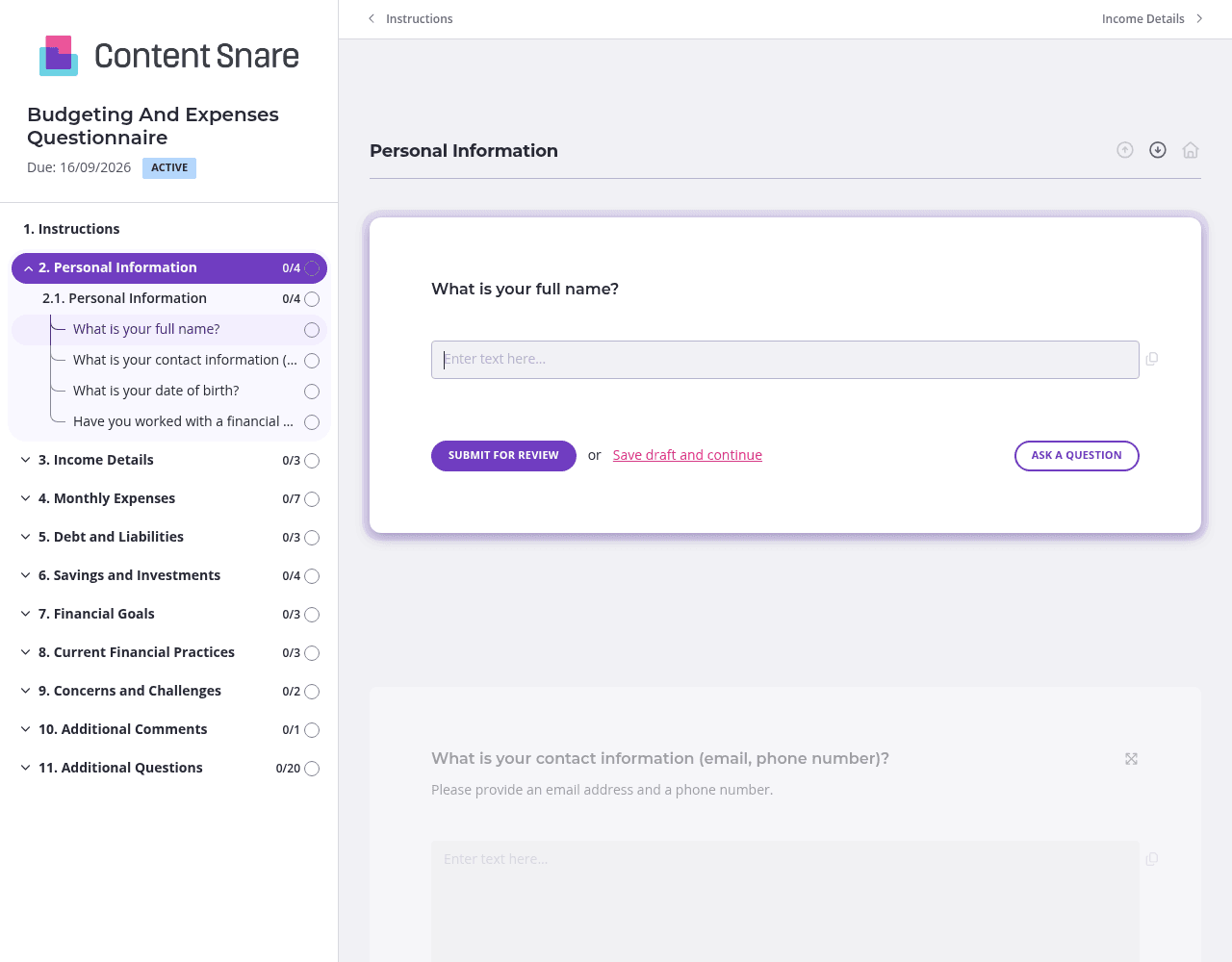
A budgeting questionnaire covers a lot of ground - income, expenses, debt, investments, and goals. Dump all those questions on one endless page and clients will procrastinate or abandon it halfway through. Content Snare lets you split the form into logical sections: one page for income details, another for monthly expenses, a third for debt and liabilities. Clients can save progress and come back later, making the whole process less overwhelming.
Questions about income fluctuations or investment types often confuse people who aren't financially savvy. Use Content Snare's instruction areas to clarify exactly what you need. For "additional sources of income," add a note like "Include rental income, side gigs, dividends, or alimony." For the emergency fund question, explain what qualifies: "Cash savings set aside specifically for unexpected expenses - not your checking account balance." Clear guidance upfront means fewer incomplete or incorrect answers.
Financial planning can't start until you have complete information, but chasing clients for their expense details wastes your time. Content Snare sends automatic follow-ups to clients who haven't finished the questionnaire, so you don't have to. You stay helpful rather than pushy, and clients get the gentle nudge they need to gather those last few credit card statements or investment account details.
Not everyone carries credit card balances or student loans. Use conditional logic to ask follow-up debt questions only when relevant. If a client answers "no" to having outstanding loans, skip the questions about loan types and monthly payments. The form stays shorter and more relevant, and clients aren't wading through sections that don't apply to them.
You could send this budgeting questionnaire as a Word document or Google Form, but those options create more work for you. Clients forget to complete sections, send files in the wrong format, or lose track of the email entirely. Content Snare is purpose-built for collecting detailed information from clients - you send one link, clients fill it out at their own pace, and everything lands in one organized place. No more chasing people down or piecing together incomplete answers.
Security matters when you're handling sensitive financial data. Content Snare is ISO 27001 certified and trusted by thousands of businesses worldwide, including financial professionals who can't afford data breaches. Your clients' income details, debt information, and investment accounts stay protected.
The platform also integrates with the tools you already use - your CRM, project management software, or client portals - so you're not manually copying data between systems. It's efficient for you, professional for clients, and backed by hundreds of 5-star reviews across G2, Capterra, and Trustpilot.
A budgeting and expenses form is just the start. Financial planners use Content Snare to collect:
One platform handles all your client information requests, keeping everything organized and moving forward.


