


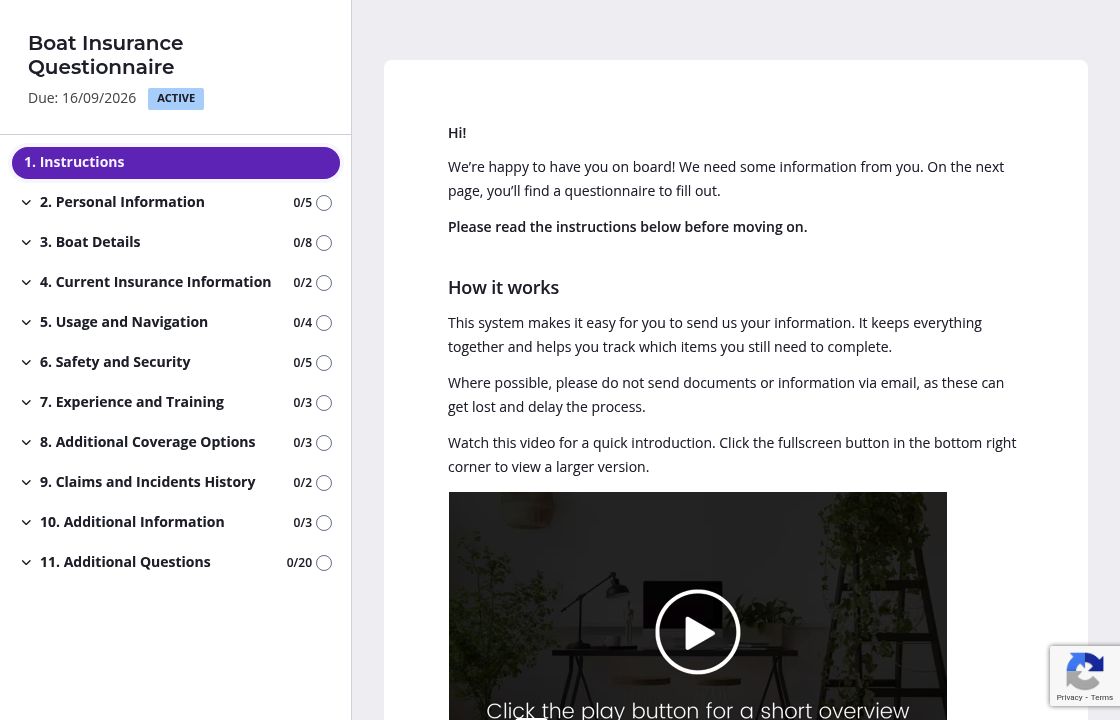
A comprehensive intake form that collects vessel specifications, owner details, usage patterns, safety equipment, claims history, and coverage preferences needed to quote boat insurance accurately.

Insurance brokers and marine insurance agents who need to gather standardized underwriting information from boat owners seeking coverage for personal watercraft, sailboats, motorboats, or yachts.

Immediately after initial prospect contact and before the first consultation call, so you can arrive at conversations with complete vessel data and move directly to coverage recommendations and quote discussions.
Incomplete client data costs you more than time - it delays quotes, creates follow-up headaches, and risks losing prospects to faster competitors. A standardized boat insurance questionnaire solves this by capturing everything you need upfront: vessel specifications, navigation patterns, safety equipment, claims history, and coverage preferences in one organized form.
This post covers how a boat insurance questionnaire streamlines your workflow, what essential questions to include (from hull IDs to EPIRB systems), and practical tips for implementation. Plus, you'll get access to a free template you can customize and deploy immediately. Here's what you need to know.
Personal Information
Capture core identifiers used for verification and policy issuance. These fields support identity checks and correspondence.
Boat Details
Gather technical specs and registration identifiers that drive rating and eligibility. Exact model, propulsion, and serial numbers help validate the risk and deter fraud.
Current Insurance Information
Confirm existing coverage and continuity. Carrier, term, and prior claims inform pricing and potential prior loss exposure.
Usage and Navigation
Define operational profile and navigational limits. Frequency, waters, and mooring determine territory and lay-up considerations.
Safety and Security
Document onboard safety and anti-theft equipment. These controls influence risk selection and discounts.
Experience and Training
Assess operator proficiency. Experience and certifications correlate with loss frequency and can unlock pricing tiers.
Additional Coverage Options
Surface optional endorsements to tailor the policy. Clarify needs up front to streamline quoting.
Claims and Incidents History
Capture material loss and violation history. These answers support risk appetite decisions and records checks.
Additional Information
Collect ownership nuances and anything non-standard. This catch-all prevents back-and-forth during binding.
Send it before the first conversation: Get the boat insurance questionnaire to prospects immediately after initial contact. You'll arrive at your first call with hull numbers, navigation patterns, and safety equipment details already in hand - turning discovery calls into quote discussions.
Flag the claims history section upfront: Let clients know the "Claims and Incidents History" questions are standard underwriting requirements, not red flags. A quick heads-up prevents hesitation and abandoned forms. Past claims don't disqualify coverage - they just help you find the right fit.
Use incomplete submissions strategically: If a client skips the "Additional Coverage Options" section, that's your opening. Follow up specifically about towing coverage or water sports protection based on their usage patterns. It shows you're reading their responses, not just processing paperwork.
Cross-reference boat details with public records: Once you receive the hull identification number and registration details, verify them before quoting. Catches data entry errors early and confirms you're insuring what the client actually owns - especially important for older vessels or recent purchases.
Create a quick-reference summary for underwriters: Pull the make/model, year, navigation area, mooring location, and safety equipment into a one-page overview after submission. Underwriters get what they need without scrolling through the full form, and you'll get quotes back faster.
You've likely collected basic contact details during the initial inquiry. Delete or pre-fill the "Personal Information" section before sending the form. Your client skips redundant questions, and you get straight to the data that matters - boat specifications, usage patterns, and coverage needs.
The "Boat Details" section asks for hull identification numbers, registration numbers, and engine specs. Most clients don't have these memorized. Add a quick instruction box with a screenshot showing where to find the HIN (typically on the transom's starboard side) and mention that registration documents contain the vessel number. Clear guidance here prevents back-and-forth emails and incomplete submissions.
Not every boat owner needs coverage for water sports activities or international trips. Set up conditional questions in the "Additional Coverage Options" and "Usage and Navigation" sections based on earlier answers. If someone indicates they only navigate inland lakes occasionally, skip the ocean-specific questions. You'll get cleaner data and clients won't wonder why you're asking about scenarios that don't apply to them.
The "Safety and Security" section is critical for underwriting but easy for clients to leave half-finished. They need to physically check the boat for EPIRB systems, fire suppression, and anti-theft devices. Automatic reminders keep the process moving without you playing the role of nag. Clients appreciate the gentle nudge, and you get complete submissions faster.
Email threads lose attachments. Shared documents get incomplete responses. Phone intake means manual data entry and transcription errors. Content Snare gives you a structured, trackable system where clients can't skip required fields, you can see exactly what's outstanding, and everything lives in one place. It's trusted by insurance brokers worldwide and integrates directly with your existing tools - no data re-entry required.
The platform is ISO 27001 certified, which matters when you're collecting hull identification numbers, registration details, and claims history. Your clients need to trust that their information is secure, and you need compliance that stands up to industry standards.
Boat insurance questionnaires are just the starting point. Insurance brokers use Content Snare for:
With hundreds of 5-star reviews across G2, Capterra, and Trustpilot, Content Snare delivers the efficiency and professionalism that turns information gathering from a bottleneck into a competitive advantage.


