
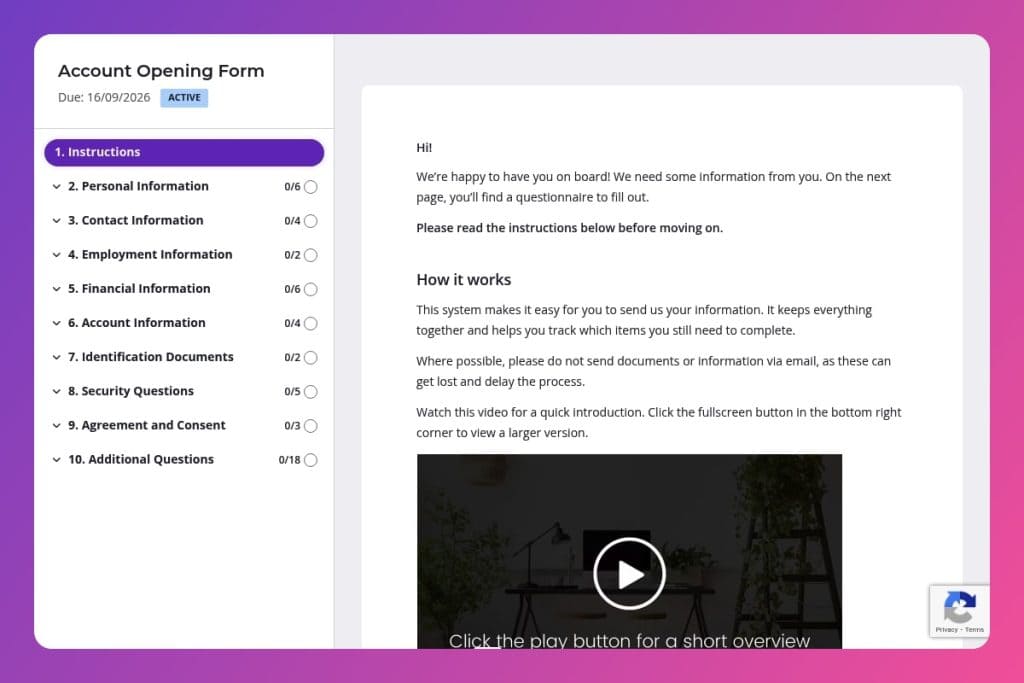


A digital form that collects personal, financial, employment, and identification information required to open a new bank account while ensuring regulatory compliance.

Bank relationship managers, branch staff, and compliance officers who need to onboard new retail or business banking customers efficiently and securely.

When a prospect decides to open a checking, savings, or other account - before account activation and after initial product selection - to gather all required documentation and approvals in one streamlined process.
Why are 67% of banking customers abandoning applications halfway through? The answer is simple: friction. Long paperwork, missing documents, unclear requirements - your account opening process can make or break the customer experience.
An account opening form solves this. It streamlines data collection, ensures regulatory compliance, and reduces errors that slow down approvals. This post covers what an effective account opening form includes, best practices for implementation, and a free template you can customize. Let's break it down.
Personal Information
Collect core identity attributes for CIP/KYC, tax reporting, and account titling.
Contact Information
Capture reliable contact and service addresses for statements, notices, and fraud screening.
Employment Information
Establish employment context for risk assessment and source-of-funds reasoning.
Financial Information
Build a financial profile for affordability checks, AML monitoring, and suitability.
Account Information
Define the product, features, and funding plan to configure the account correctly.
Identification Documents
Request documentary evidence to satisfy CIP and address verification.
Security Questions
Set communication preferences and authentication controls at onboarding.
Agreement and Consent
Capture enforceable consent for disclosures, credit checks, and data processing.
Pre-fill employment and financial sections when possible: If you're working with existing customers who already have a relationship with your bank, pull their employment history or income data from previous applications. This cuts completion time in half and shows customers you value their time.
Guide customers through document preparation upfront: Before sending the form, provide a simple checklist of what they'll need - government ID, proof of address, initial deposit method. Most abandonment happens when customers hit the identification documents section unprepared. A quick email or text with "Here's what to gather before you start" prevents frustration and incomplete submissions.
Follow up on financial information gaps within 24 hours: The financial information section often reveals incomplete answers about income sources or existing obligations. Don't wait days to clarify. A quick call to confirm details keeps momentum going and demonstrates responsiveness, turning a potential drop-off into a completed account.
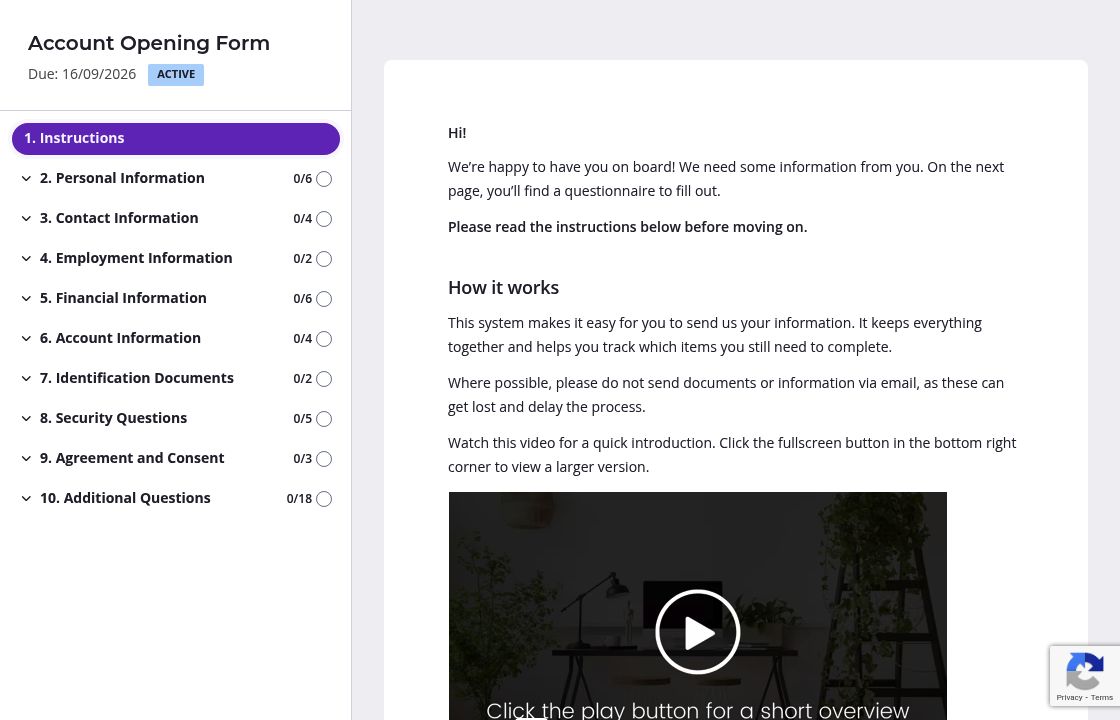
Account opening forms cover a lot of ground - personal details, employment history, financial information, identification documents. Content Snare lets you split these into separate pages so customers aren't overwhelmed by a wall of questions. Group related fields together: one page for personal and contact info, another for employment and financials, a final page for security preferences and consent. Customers can save progress between pages, which dramatically reduces abandonment.
Not every customer needs to answer every question. Someone opening a basic savings account doesn't need the same follow-up questions as someone applying for premium services. Use conditional logic to show additional product offerings or financial asset questions only when relevant. Ask about dependents or joint account holders only when marital status indicates it's necessary. This keeps the form lean and respects your customer's time.
The identification documents and financial information sections trip people up most often. Content Snare lets you include clear instructions directly above these question groups. Add a quick note about acceptable ID types (driver's license, passport) or specify the format you need for income documentation. Include a sample image of an acceptable proof of address document. These small clarifications eliminate back-and-forth emails and get you complete, accurate submissions the first time.
Customers start applications with good intentions, then life gets in the way. Content Snare handles follow-up automatically so you don't have to chase people down or worry about seeming pushy. The system sends gentle reminders at intervals you choose, keeping applications moving without eating up your team's time. You'll close more accounts simply because fewer applications fall through the cracks.
PDFs and email chains create chaos. Customers don't know what information you still need. Your team wastes hours chasing missing documents and clarifying confusing answers. Content Snare eliminates the back-and-forth with a purpose-built platform that guides customers through each step, tracks exactly what's outstanding, and keeps everything organized in one place.
Security matters in banking. Content Snare is ISO 27001 certified and trusted by financial institutions worldwide. Your customers can submit sensitive information like Social Security Numbers and financial data with confidence. The platform integrates seamlessly with your existing tools - your CRM, document management system, or compliance software - so data flows where it needs to go without manual entry.
Account opening forms are just the starting point. Banks use Content Snare for loan applications, KYC documentation updates, business banking onboarding, mortgage pre-qualification forms, and credit card applications. Any process where you're collecting information from customers becomes faster and more professional.
Thousands of businesses rely on Content Snare, with hundreds of 5-star reviews across G2, Capterra, and Trustpilot. The platform is highly customizable to match your specific compliance requirements and branding standards, turning a traditionally frustrating process into a seamless customer experience.


