
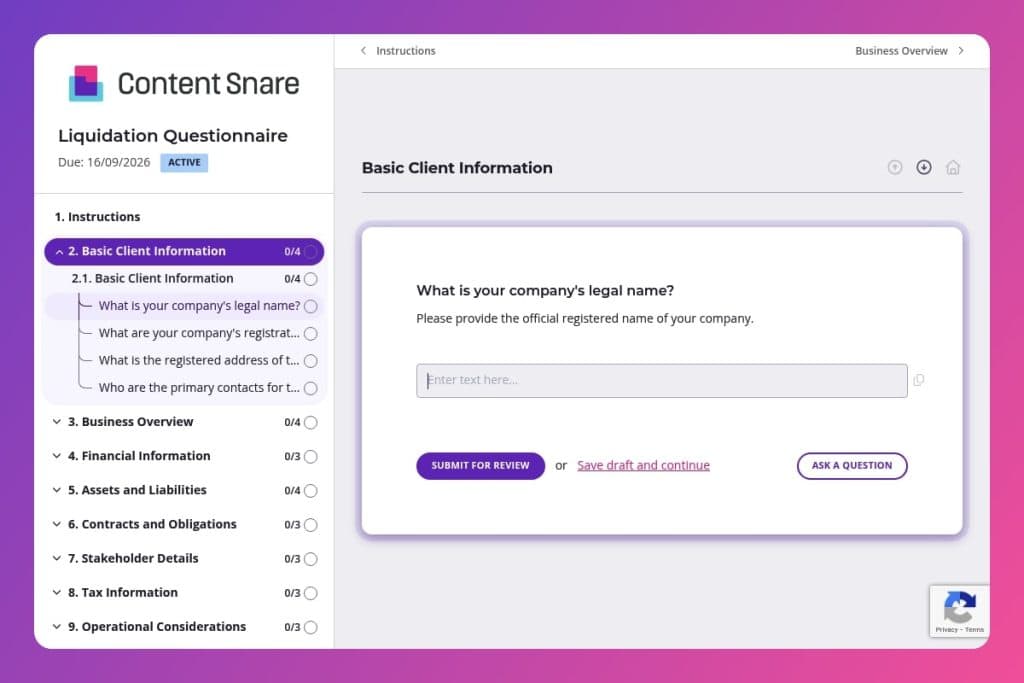


A comprehensive intake form that collects financial records, asset inventories, creditor details, stakeholder information, and legal obligations needed to manage a company liquidation.

Accountants, insolvency practitioners, and liquidators who need to gather complete client information before initiating formal liquidation proceedings.

Send this form 48-72 hours before the initial liquidation consultation so clients can compile financial statements, tax records, and stakeholder details in advance.
Liquidating a company means tracking down scattered financial records, chasing stakeholder details, and answering the same questions across multiple meetings. You're juggling creditor lists, asset inventories, tax filings, and contract obligations - all while ensuring nothing falls through the cracks during an already stressful process.
A liquidation questionnaire solves this problem by gathering all critical information upfront in one organized form. You'll learn what questions to ask, how to structure the process efficiently, and get a free template to start using today. Let's dive in.
Basic Client Information
These establish identity and the people who will engage on the file. Accurate details prevent delays in notices and filings.
Business Overview
This frames the company’s context, scale, and the driver for liquidation. It informs stakeholder messaging and the choice of process.
Financial Information
These establish solvency, cash runway, and creditor exposure. They underpin the liquidation plan and immediate cash controls.
Assets and Liabilities
This maps realizable value, encumbrances, and obligations. It guides sale strategy and recovery expectations.
Contracts and Obligations
This surfaces termination requirements and contingent exposures. Early identification reduces leakage and disputes.
Stakeholder Details
This identifies ownership, governance, and employee-related claims. These shape approvals and priority considerations.
Tax Information
This clarifies filing gaps, remittance status, and audit risk. It informs clearances and required reserves.
Operational Considerations
This captures site exits and asset disposition needs. It aligns logistics, security, and handback obligations.
Closing Procedures
This aligns timeline, regulatory path, and decision authority. It sets the critical path and communication cadence.
Additional Information
This catches edge cases and expectations not covered above. It helps preempt surprises.
Send the form before your first meeting: Give clients 48-72 hours to complete the liquidation questionnaire in advance. They'll need time to gather financial statements, creditor lists, and asset inventories - documents that aren't always immediately accessible. You'll walk into that initial consultation with a complete picture instead of spending billable hours chasing basics.
Flag the stakeholder and tax sections as priorities: Clients often underestimate the complexity of shareholder details and outstanding tax obligations. When you send the form, explicitly mention these areas need thorough attention. Missing even one shareholder or unreported tax assessment can derail timelines and create legal headaches down the line.
Use the completed form as your project roadmap: Once submitted, turn the responses into a liquidation checklist. The contracts section tells you what needs terminating, the assets section shows what requires valuation, and the operational details reveal lease obligations to address. You've essentially got a customized project plan built from the client's own data.
Schedule a review call for complex financial information: Don't just accept the balance sheet and creditor list at face value. Book a 30-minute follow-up to walk through the financial and liabilities sections together. Clients sometimes misclassify debts, forget contingent liabilities, or provide outdated figures - catching these early saves corrections later.
Keep the completed form as your single source of truth: Reference it throughout the liquidation process when questions arise about timelines, regulatory requirements, or stakeholder concerns. It documents the client's initial state and expectations, which protects both parties if disputes emerge about what was disclosed when.
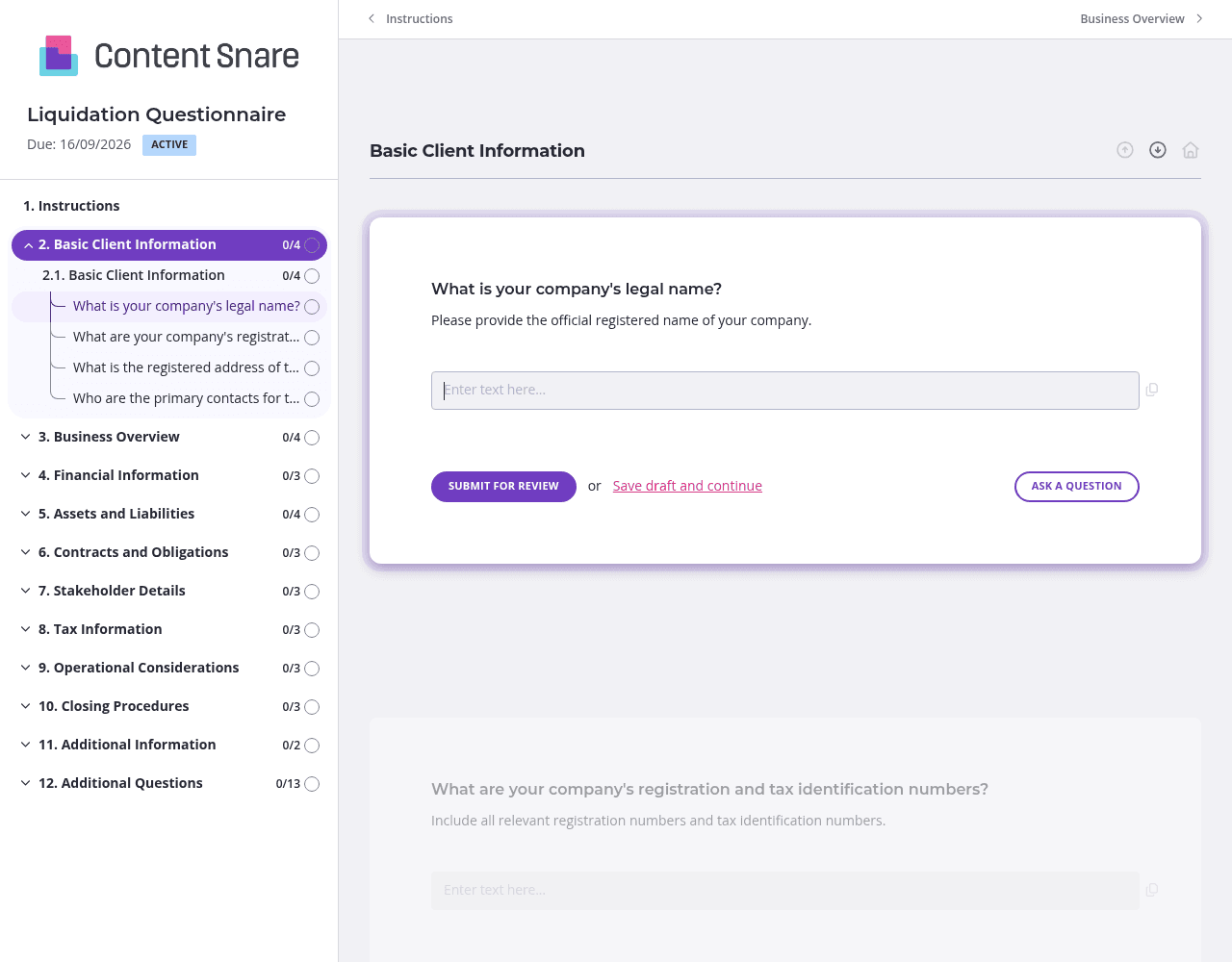
Liquidation involves dense financial and legal information. Split your questionnaire into logical pages - one for financial statements and cash flow, another for assets and liabilities, a third for contracts and legal obligations. Clients won't feel overwhelmed staring at 40+ questions at once. They can tackle the financial page when they have their accountant available, then return later to handle operational details with their facilities manager.
The tax information and stakeholder sections need precision. Use instruction fields to clarify exactly what you need: "Include all subsidiaries and associated entities" for registration numbers, or "List shareholders as they appear in your corporate registry, including percentage ownership" for stakeholder details. A two-sentence instruction prevents back-and-forth emails asking clients to resubmit corrected information.
Clients dealing with liquidation are juggling creditor calls, employee concerns, and legal deadlines. They'll forget to complete your form. Configure reminders to send every 3-4 days after the initial request. You stay top of mind without sending awkward "just following up" emails, and clients appreciate the nudge when they're drowning in competing priorities.
You likely have basic client information - legal name, registration numbers, contact details - in your practice management system. Pre-fill those fields or delete them entirely before sending. Your client focuses energy on the complex stuff: creditor lists, asset valuations, and contract obligations. Less friction means faster completion and fewer abandoned forms.
Email threads lose attachments. Spreadsheets get overwritten. Phone calls miss critical details. Content Snare centralizes everything in one secure, tracked system - so nothing falls through the cracks during a high-stakes liquidation process. Clients submit information once, correctly, and you have a complete audit trail from start to finish.
Content Snare is ISO 27001 certified and trusted by accounting firms worldwide who handle sensitive financial data daily. You get bank-level security for tax filings, creditor lists, and shareholder information without building custom infrastructure.
The platform integrates with tools you already use - your practice management software, cloud storage, and communication systems. No double entry. No manual downloads. Just seamless workflows that save hours per engagement.
Thousands of accounting professionals rely on Content Snare with hundreds of 5-star reviews across G2, Capterra, and the Xero App Store. They've moved past chasing clients for information and turned data collection into a professional, efficient experience.
This form is just one application. Accounting firms use Content Snare for:
Each questionnaire adapts to your firm's workflow while maintaining the same professional client experience.


