
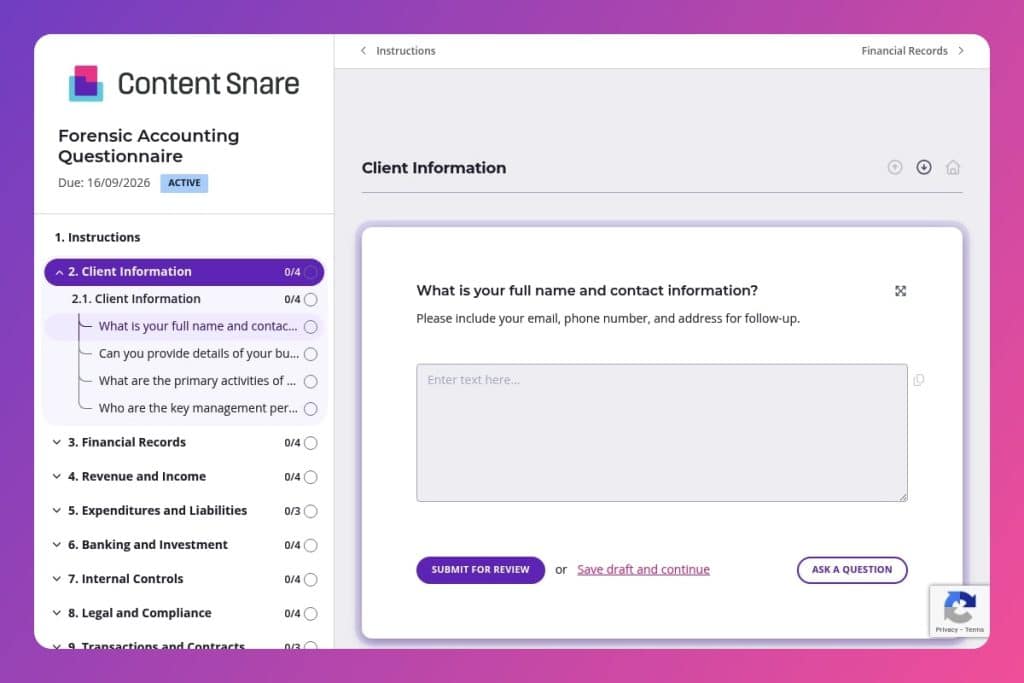


A comprehensive client intake form that collects financial records, business operations details, internal controls, and potential fraud indicators for forensic accounting investigations.

Forensic accountants, fraud examiners, and accounting firms conducting fraud investigations, litigation support, or financial dispute analysis for businesses and individuals.

Send this 48-72 hours before initial client consultations to gather essential documents and information upfront, enabling your first meeting to focus on strategic analysis rather than basic data collection.
A suspected fraud case lands on your desk. You need answers fast - but clients arrive unprepared, financial records are scattered, and critical details slip through the cracks. Every missing document delays your investigation and increases your firm's liability exposure.
A forensic accounting questionnaire solves this problem. It standardizes your client intake process, ensures you collect every essential detail upfront, and protects you from overlooking red flags. This post covers what the form should include, how to use it effectively in fraud investigations and litigation support, and gives you a free template to customize for your practice. Let's break it down.
Client Information
This group confirms identity, legal form, core activities, and decision-makers to set authority and communication lines.
Financial Records
Define the record set, systems, storage, and access to plan evidence collection and completeness testing.
Revenue and Income
Map revenue streams, source documents, anomalies, and cash handling to target occurrence and cut-off work.
Expenditures and Liabilities
Profile spend categories and obligations to assess completeness and recent changes affecting risk.
Banking and Investment
Surface banking footprint, debt terms, reconciliations, and investments for third-party corroboration.
Internal Controls
Capture control design, frequency, responsibilities, and known gaps to focus fraud-risk work.
Legal and Compliance
Identify litigation, key contracts, compliance mechanisms, and regulatory touchpoints that influence scope.
Transactions and Contracts
Capture significant agreements, related parties, and vendor governance to flag conflict and documentation risk.
Assets and Inventory
Document major assets, valuation methods, and discrepancies to guide existence and valuation work.
Employee and Payroll Information
Outline payroll data sources, reimbursement processes, and benefits issues relevant to misstatement risk.
Insurance and Risk Management
Document risk transfer, loss history, and mitigation practices to contextualize exposure.
External Services
Note external preparers and advisors to understand reliance and alternate data sources.
Miscellaneous
Allow space for client-identified hotspots, objectives, and supplemental materials to fine-tune scope.
Send the form before your initial consultation: Give clients 48-72 hours to gather documents and complete the questionnaire before you meet. This turns your first conversation into a strategic discussion rather than a data-collection session, and you'll spot inconsistencies or gaps worth probing during the meeting.
Flag the "special attention" question early: The miscellaneous section asks clients what areas they believe need focus. Review this answer first - it reveals their concerns and biases, which helps you stay objective and ensures you don't miss red flags they're trying to downplay or overemphasize.
Request supporting documents alongside answers: When clients answer questions about financial statements, bank accounts, or contracts, have them upload the actual documents in the same submission. You'll avoid the back-and-forth email chains and build a complete case file from day one.
Use incomplete responses as interview prompts: Clients often skip questions about internal control weaknesses, related-party transactions, or irregular revenue entries - either because they don't know or don't want to disclose. Note these gaps and address them directly in your follow-up interview. Silence speaks volumes in forensic work.
Create a response timeline tracker: After submission, map out which questions require immediate action (like securing access to financial records) versus longer-term investigation (such as reviewing employment contracts or insurance claims). This helps you prioritize fieldwork and keeps complex engagements on track.
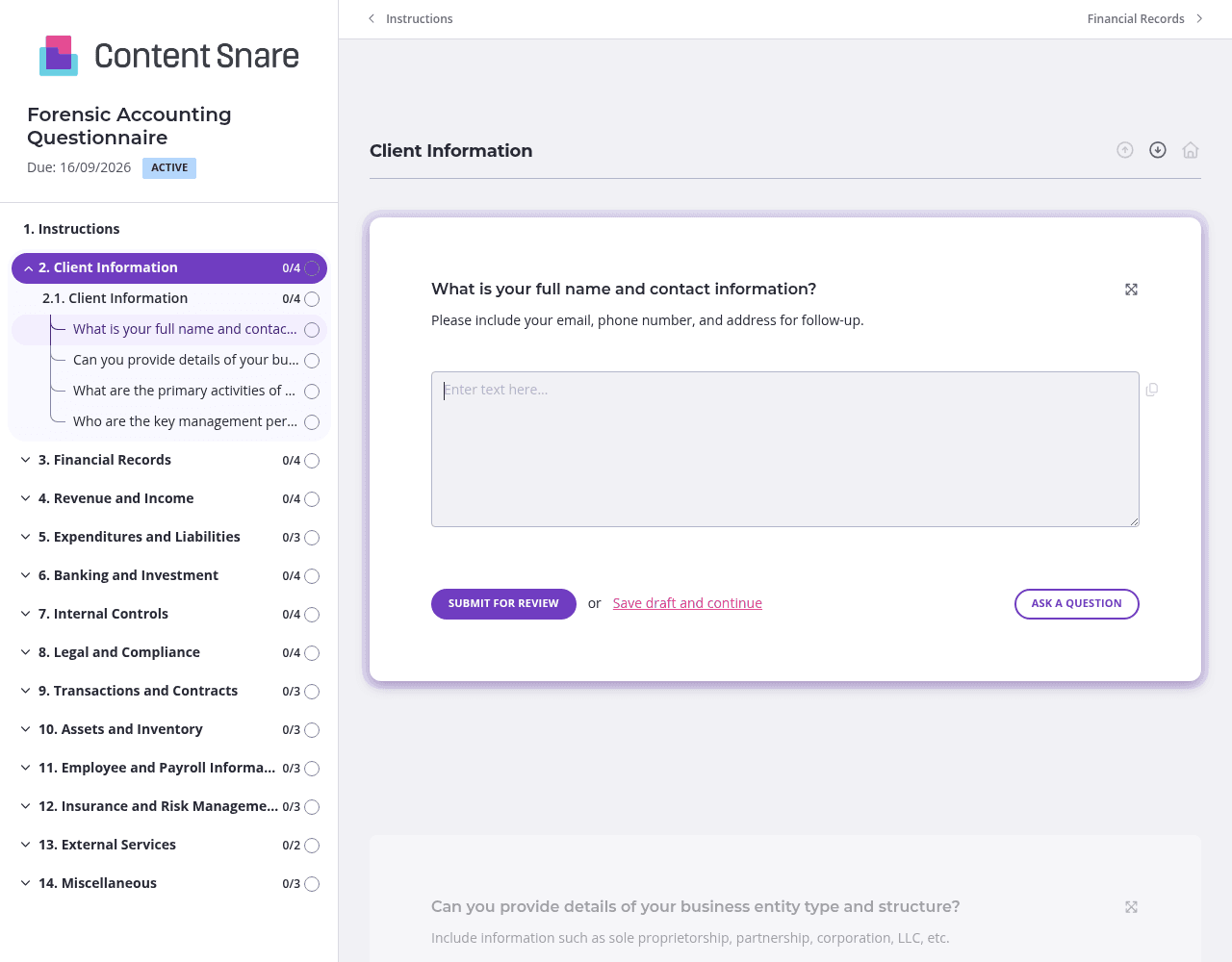
Forensic accounting questionnaires overwhelm clients when presented as one endless scroll. Content Snare lets you organize questions into logical pages - Client Information, Financial Records, Banking & Investment, Internal Controls, and Legal & Compliance. Clients tackle one section at a time, and you get higher completion rates. They see progress as they move through each page, which keeps momentum going even when gathering sensitive documents like bank statements or contracts.
Questions about internal control weaknesses or unusual revenue entries often get superficial responses. Content Snare's instruction fields let you guide clients on what "detailed" actually means. Under the internal controls section, add a note: "List specific approval processes, separation of duties, and any instances where controls were bypassed." For banking questions, specify: "Include all accounts - business, personal accounts used for business, and any accounts closed in the last 24 months." Clear instructions upfront save you from chasing clarifications later.
You likely already have basic client details - business name, entity type, key contacts - from your engagement letter or intake call. Prefill these fields before sending the form. Clients appreciate not re-entering information you already know, and it signals you're organized and attentive. They'll focus energy on the complex questions that actually require their input, like explaining related-party transactions or flagging discrepancies in asset records.
Clients juggle legal counsel, internal teams, and their own anxiety during forensic investigations. They forget deadlines. Content Snare's automatic reminders handle follow-up for you - gentle nudges that keep cases moving without awkward phone calls. You stay on schedule, clients don't feel nagged, and you maintain the professional distance critical in forensic engagements.
Email threads lose attachments. Shared drives become disorganized messes. Word documents and PDFs get ignored for weeks. Content Snare replaces this chaos with a purpose-built client information platform that tracks what's submitted, what's missing, and who's responsible - critical when you're managing sensitive forensic investigations where every document matters.
Security is non-negotiable in forensic work. Content Snare is ISO 27001 certified and trusted by accounting firms worldwide to handle confidential financial data, legal documents, and sensitive client information. Your clients upload bank statements, contracts, and payroll records knowing their data is protected.
The platform integrates with tools you already use - your practice management software, cloud storage, and accounting systems. No duplicate data entry. No switching between platforms to check submission status.
Thousands of businesses trust Content Snare, with hundreds of five-star reviews across G2, Capterra, and Trustpilot highlighting how it transforms client communication from frustrating to effortless.
This forensic accounting questionnaire is just one application. Accounting professionals use Content Snare for:
Every workflow where you need information from clients becomes faster, more organized, and professionally managed.


