
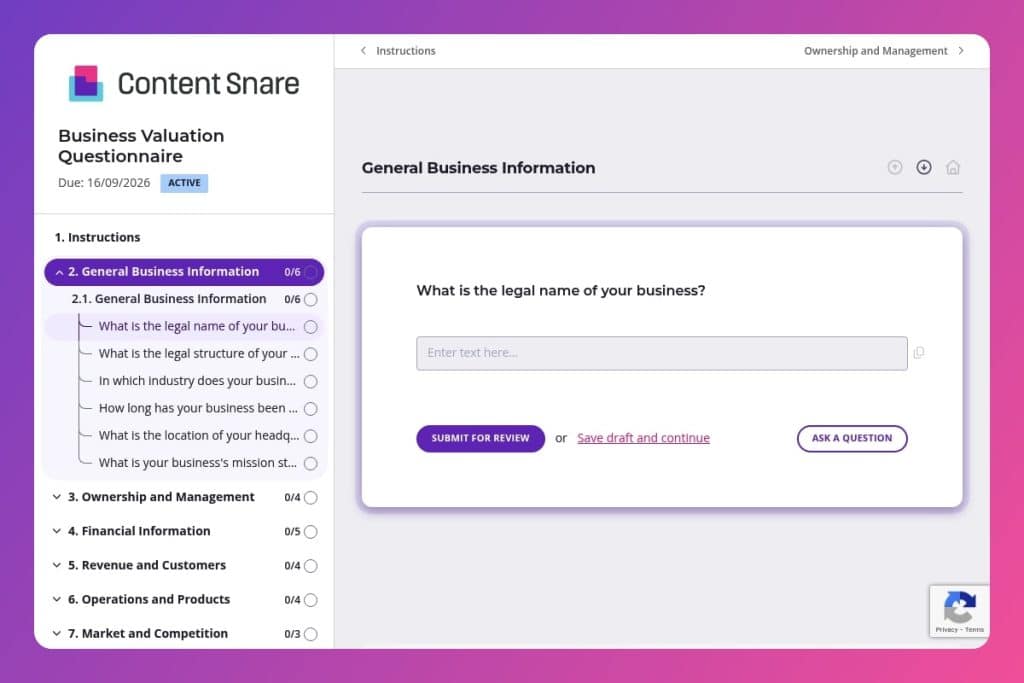


A comprehensive intake form that collects financial statements, ownership structure, revenue sources, operational details, and market positioning needed to conduct accurate business valuations.

Accounting firms and valuation specialists who need to gather complete client data - from three years of financials to customer contracts and competitive analysis - before beginning valuation work.

Send this at the start of every valuation engagement, immediately after the client agreement is signed, to collect all necessary information before your analysis begins.
How many hours do you waste each year chasing clients for incomplete valuation data? Accountants know the drill: endless email threads, missing financial statements, vague answers about ownership structure, and clients who can't articulate their revenue streams. The result? Delayed valuations, frustrated clients, and billable hours lost to administrative back-and-forth.
A business valuation questionnaire solves this headache upfront. This digital form collects everything you need - financial statements, ownership details, customer contracts, competitive positioning - in one organized submission. You'll discover what makes an effective questionnaire, how to customize it for different clients, and get access to a free template you can deploy immediately. Let's dive in.
General Business Information
Capture core identifiers and context to frame the valuation.
Ownership and Management
Clarify current ownership, leadership structure, and decision authority. Also flag pending changes that affect control and risk.
Financial Information
Establish the financial baseline and reporting framework, plus capital structure and obligations that influence value and risk.
Revenue and Customers
Map revenue mix, key accounts, contract durability, and retention.
Operations and Products
Document offerings, capacity, asset posture, and operational constraints.
Market and Competition
Position the business within its competitive set and macro forces.
Growth and Strategy
Surface strategy horizon, expansion plans, and near-term initiatives.
Legal and Regulatory
Identify legal exposures, licensing, and compliance posture.
Human Resources
Quantify workforce scale, critical talent, and stability.
Technology and Systems
Inventory core platforms and planned changes that impact scalability or risk.
Risk Management
Identify principal risks and risk transfer strategies.
Other Information
Provide an open field for context not captured elsewhere.
Send a prep email before the form: Let clients know they'll need last three years of financials, ownership percentages, and customer retention data ready. A 48-hour heads-up means fewer half-completed submissions and faster turnaround.
Frame the questionnaire as collaboration, not interrogation: When introducing the form, explain how thorough answers lead to more accurate valuations and better strategic advice. Clients engage more seriously when they understand that vague responses about competitors or operational challenges directly impact the final valuation quality.
Flag the mission-critical questions upfront: Tell clients that sections on financial statements, capital structure, and outstanding obligations are non-negotiable for completion. Everything else adds context and precision, but those core financial areas are the foundation you absolutely need before moving forward.
Schedule a 15-minute follow-up call after submission: Even complete forms benefit from clarification. Use this brief conversation to dig deeper on operational challenges they mentioned, verify any unusual financial agreements, or explore those "other details" they added at the end. You'll catch nuances that written responses miss.
Create a checklist from their answers: Convert their submission into a document request list organized by section - financials, legal documents, customer contracts, insurance policies. This transforms their questionnaire responses into your roadmap for gathering supporting documentation, keeping the entire valuation process structured and efficient.
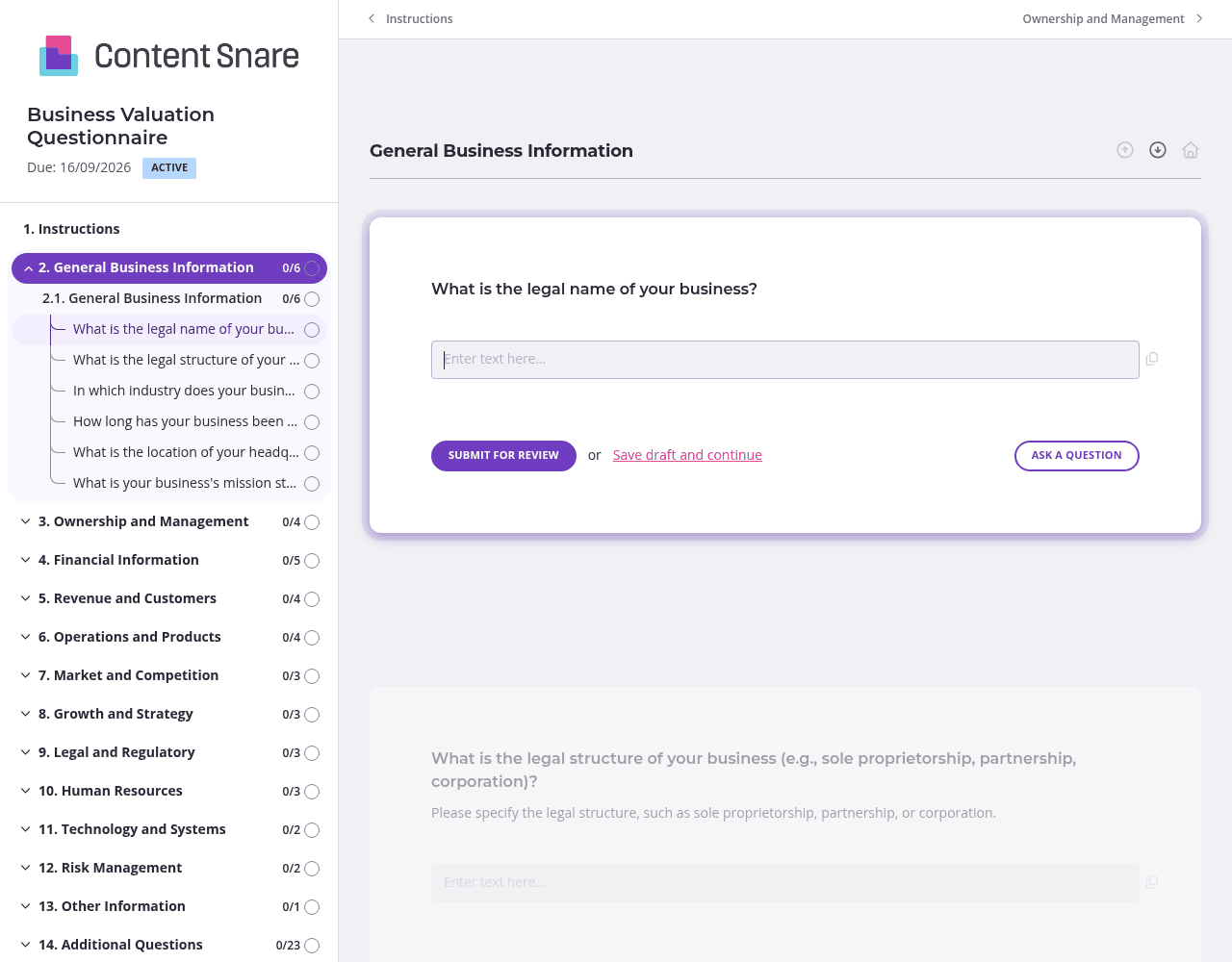
Business valuations cover enormous ground - from financial statements to competitive positioning to risk management. Structure your questionnaire across separate pages: one for financial information, another for operations and products, a third for market analysis. Clients can complete the financial section while their accountant pulls statements, then return later to tackle strategic questions with their executive team. The progress bar shows them exactly how much remains, reducing abandonment.
The financial information section makes or breaks your valuation accuracy. Add instruction text above those questions explaining exactly what you need: "Upload complete income statements, balance sheets, and cash flow statements for the last three fiscal years - not just summaries or excerpts." Include a sample screenshot showing proper formatting. Clients submit cleaner data when they understand your requirements upfront, saving you hours of clarification emails.
Your clients are running companies - they're juggling payroll, supplier negotiations, and customer crises. That valuation questionnaire slips down their priority list fast. Content Snare sends gentle automated reminders at intervals you choose, keeping the form on their radar without awkward follow-up calls from you. They appreciate the nudge, you get timely responses, and nobody feels like the villain.
You likely know the legal business name, structure, headquarters location, and employee count before starting the valuation. Pre-populate those fields so clients open the form seeing progress already made. Delete questions entirely if they're irrelevant - a sole proprietor doesn't need ownership percentage questions. This customization shows attentiveness and reduces their workload to just the information you genuinely need from them.
Email chains lose attachments. Shared drives become filing nightmares. Phone calls mean transcribing notes and second-guessing what clients actually said. Content Snare centralizes everything - questions, file uploads, communication - in one organized system that tracks progress automatically and keeps sensitive financial data ISO 27001 certified secure.
Thousands of accounting firms worldwide trust Content Snare because it transforms chaotic client interactions into structured workflows. Your clients get a professional, branded experience. You get complete submissions without the follow-up fatigue.
The platform integrates seamlessly with tools you already use - your practice management software, cloud storage, and communication systems. Customization means you build forms that match your exact process, not the other way around. And with hundreds of 5-star reviews across G2, Capterra, and the Xero App Store, you're choosing a solution accountants actually recommend.
Content Snare works for any scenario where you need client information:
One platform handles every information-gathering scenario your practice faces.


