
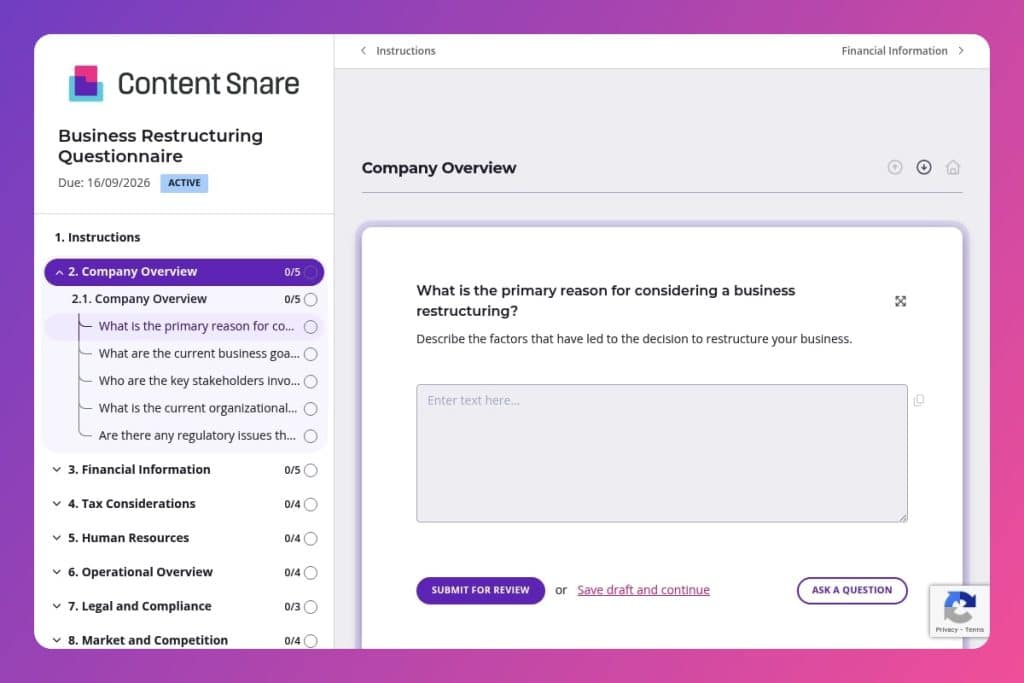


A comprehensive intake form that gathers financial data, tax structure, operational challenges, staffing details, and compliance issues from clients considering business restructuring.

Accounting professionals and advisory firms working with business clients who need to assess restructuring options, tax implications, and financial viability before developing strategic recommendations.

Send this 48 hours before initial restructuring consultations to collect financial statements, debt schedules, and stakeholder information so you can skip fact-finding and focus on strategic planning during the meeting.
Your client mentions "restructuring" in a Monday morning call. You schedule a follow-up meeting, but walk in without a clear picture of their financial position, tax structure, or operational pain points. The conversation jumps between debts, staffing concerns, and compliance gaps - leaving you scrambling to piece together what they actually need.
A business restructuring questionnaire changes that. It captures everything upfront: financial statements, tax considerations, staffing impacts, regulatory issues, and timeline expectations. This post walks you through what to include in your form, how to use it during client engagements, and gives you a ready-to-use template. Let's dive in.
Company Overview
These items capture strategic intent, key actors, current structure, and regulatory constraints that shape feasible paths.
Financial Information
Collect financials and drivers to assess viability and model scenarios.
Tax Considerations
Clarify current tax posture, exposure, and restructuring impacts to prevent adverse outcomes.
Human Resources
Map workforce scale, pay structure, and contract constraints to anticipate people impacts.
Operational Overview
Surface process architecture, bottlenecks, and planned changes that will inform design and sequencing.
Legal and Compliance
Identify liabilities and obligations so you can align the structure with regulatory requirements.
Market and Competition
Anchor the plan in market position, competitive landscape, and post-change growth vectors.
Information Technology
Inventory systems, integration needs, and security posture to size IT workstreams.
Risk Management
Capture core risks, current treatments, and changes required under the new model.
Miscellaneous
Use these to capture timing and any out-of-scope drivers that may affect approach.
Send it before the initial consultation: Get the questionnaire to your client 48 hours ahead of your first meeting. They'll need time to gather financial statements, review debt schedules, and consult with key stakeholders. Walking into that meeting with completed answers means you can skip the fact-finding phase and move straight into strategic recommendations.
Flag incomplete financial sections immediately: If a client submits the form without attaching balance sheets or leaves tax compliance questions blank, follow up within 24 hours. Missing financial data or vague answers about existing liabilities will stall your entire restructuring plan. A quick email asking for specifics - "Can you attach Q4 financials and clarify the outstanding loan amounts?" - saves you from playing catch-up later.
Use their answers to build your engagement scope: Don't just file away the responses. Their answers about operational inefficiencies, staffing changes, and regulatory concerns tell you exactly which services they need. If they mention pending legal issues or anticipated tax implications, those become line items in your proposal. The questionnaire doubles as a scoping tool that protects you from scope creep down the road.
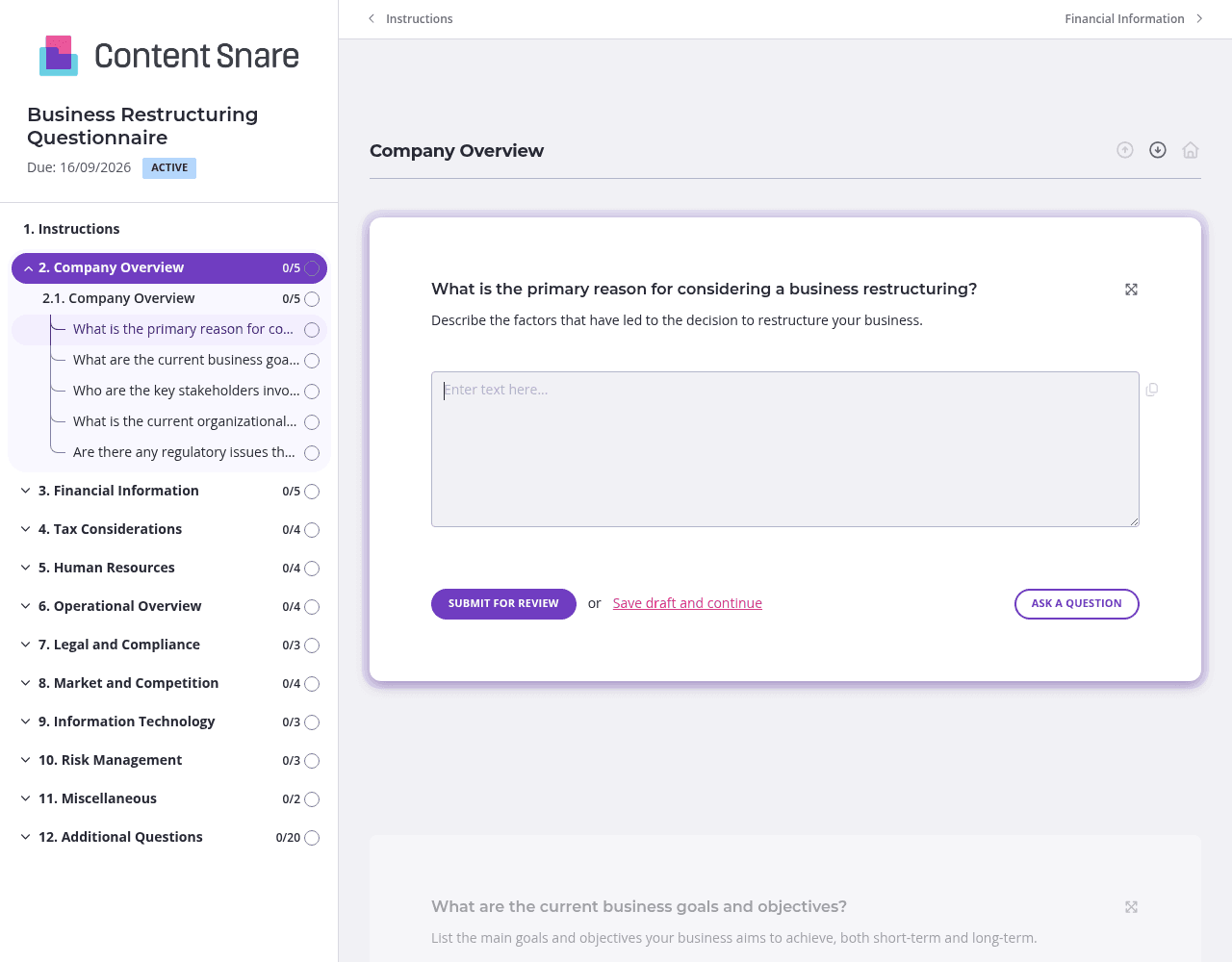
A business restructuring questionnaire covers everything from financial statements to IT systems to risk management. That's overwhelming in one long scroll. Split it into separate pages: Company Overview, Financial Information, Tax Considerations, Human Resources, and so on. Your client tackles one section at a time, submits what they have, and moves forward. You get partial responses instead of radio silence because they got stuck on a debt schedule question.
Your client doesn't know which financial statements you need or how detailed their operational challenges should be. Add short instructions above tricky sections. For "latest financial statements," specify: "Upload your most recent income statement, balance sheet, and cash flow statement - preferably for the last 12 months." For questions about tax implications or regulatory issues, clarify whether you want a paragraph summary or bullet points. Clear guidance upfront means fewer follow-up emails asking for clarification.
You likely have basic company details, current tax structure, or employee counts from previous work together. Prefill those fields before sending the form. Your client sees half the Company Overview section already completed, which makes the whole questionnaire feel less daunting. It also signals you've done your homework and aren't treating them like a brand-new client.
The Financial Information and Legal & Compliance sections require attachments - balance sheets, payroll records, pending lawsuit details. Clients forget or procrastinate. Automatic reminders nudge them without you sending "just checking in" emails that feel pushy. They get a friendly prompt, you get the documents you need to move forward, and nobody feels awkward about it.
Email threads turn into chaos when you're collecting restructuring details. Clients attach outdated financials, forget which questions they've answered, and you lose track of what's still missing. Spreadsheets aren't much better - clients overwrite formulas, skip required fields, and you still chase documents manually. Content Snare gives you a single place to collect everything, with automatic reminders and real-time tracking so nothing falls through the cracks.
Thousands of accounting firms use Content Snare because it's built for client collaboration. It's ISO 27001 certified, which matters when you're handling sensitive financial data and tax records. Clients get a clean, professional interface that doesn't feel like homework. You get organized responses and automatic follow-ups without the awkward nudging.
It integrates with the tools you already use - your practice management software, cloud storage, and workflow apps. Hundreds of five-star reviews across G2, Capterra, and the Xero App Store back this up.
This form is just one way to use Content Snare. Accounting firms also use it for:


