
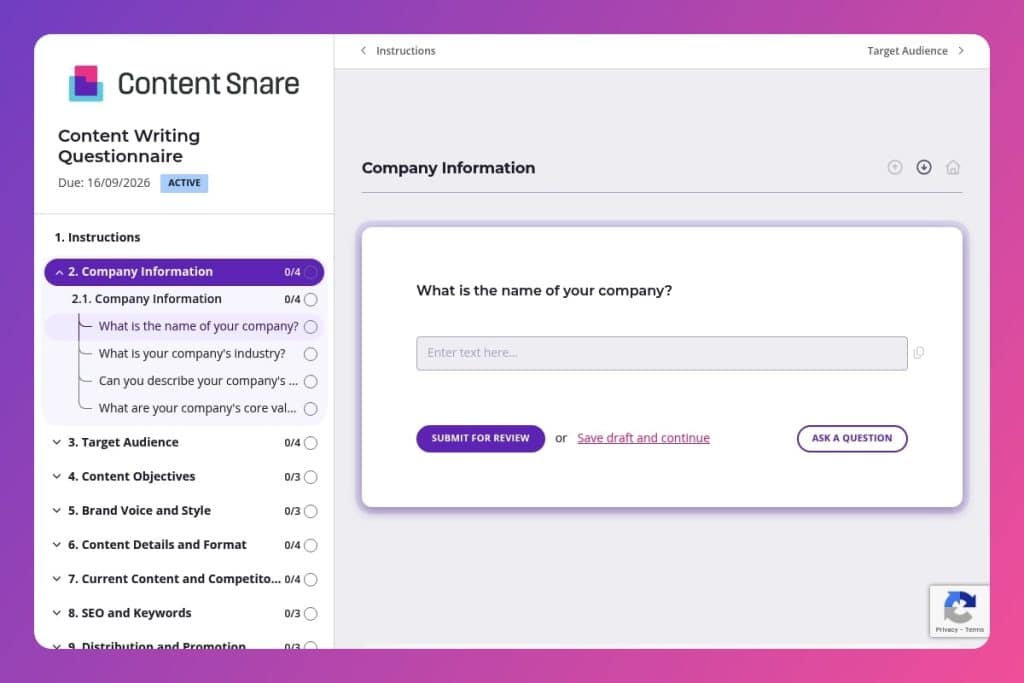


A structured intake form that captures brand guidelines, audience details, content objectives, SEO requirements, and approval workflows before writers begin work.

Digital agencies managing multiple content projects with freelance writers or in-house teams who need clear, consistent briefs to avoid revision cycles and scope creep.

Send this 24-48 hours before project kickoff calls or when onboarding new content assignments to establish requirements upfront and create writer briefs from client responses.
How many client revisions could you avoid if your writers actually understood the brief the first time? For digital agencies juggling multiple content projects, miscommunication with freelancers and in-house writers isn't just frustrating - it's expensive. Vague briefs lead to missed deadlines, off-brand copy, and endless revision rounds that eat into your margins.
A content writing questionnaire fixes this. It captures everything your writers need upfront: brand voice, target audience, SEO requirements, content objectives, and approval processes. This post covers what to include in your questionnaire, how to use it effectively across projects, and gives you a free template to customize. Let's break it down.
Company Information
Establish foundational context to keep positioning and messaging aligned.
Target Audience
Define who you’re writing for to tailor angles, examples, and CTAs.
Content Objectives
Clarify success criteria so scope, messaging, and measurement stay focused.
Brand Voice and Style
Set voice controls to maintain consistency and protect brand equity.
Content Details and Format
Lock down deliverable parameters to prevent rework and mismatched expectations.
Current Content and Competitors
Audit the landscape to position the piece and avoid duplication.
SEO and Keywords
Set the search brief so structure and language support discoverability.
Distribution and Promotion
Plan amplification early so content is built for channel fit and velocity.
Feedback and Evaluation
Define workflow and ownership to keep production smooth and accountable.
Budget and Timeline
Set constraints upfront to calibrate effort, resourcing, and sequencing.
Send it before the kickoff call: Get clients to complete the content writing questionnaire 24-48 hours before your initial meeting. You'll arrive prepared with specific questions about their brand voice or SEO goals, rather than spending the first call gathering basic information.
Use it as a scoping tool, not just a brief: The budget and timeline questions help you spot scope creep early. If a client wants SEO-optimized long-form content across multiple formats but has a limited budget, you can address that mismatch upfront instead of discovering it mid-project.
Pre-fill what you already know: Already worked with this client before? Fill in their company information, target audience, and brand voice details before sending the form. This saves them time and shows you're paying attention - they'll only need to update what's changed or add project-specific details.
Flag the competitor content section during follow-up: Clients often skip the questions about competitor content they admire or dislike. Circle back on this specifically - it's one of the fastest ways to understand what they actually want without relying on subjective descriptions like "professional but fun."
Create a writer handoff document from their responses: Don't just forward the raw form responses to your writers. Pull out the critical details - brand voice examples, target keywords, prohibited terminology, and content objectives - into a clean brief. Your writers will thank you, and you'll get better first drafts.
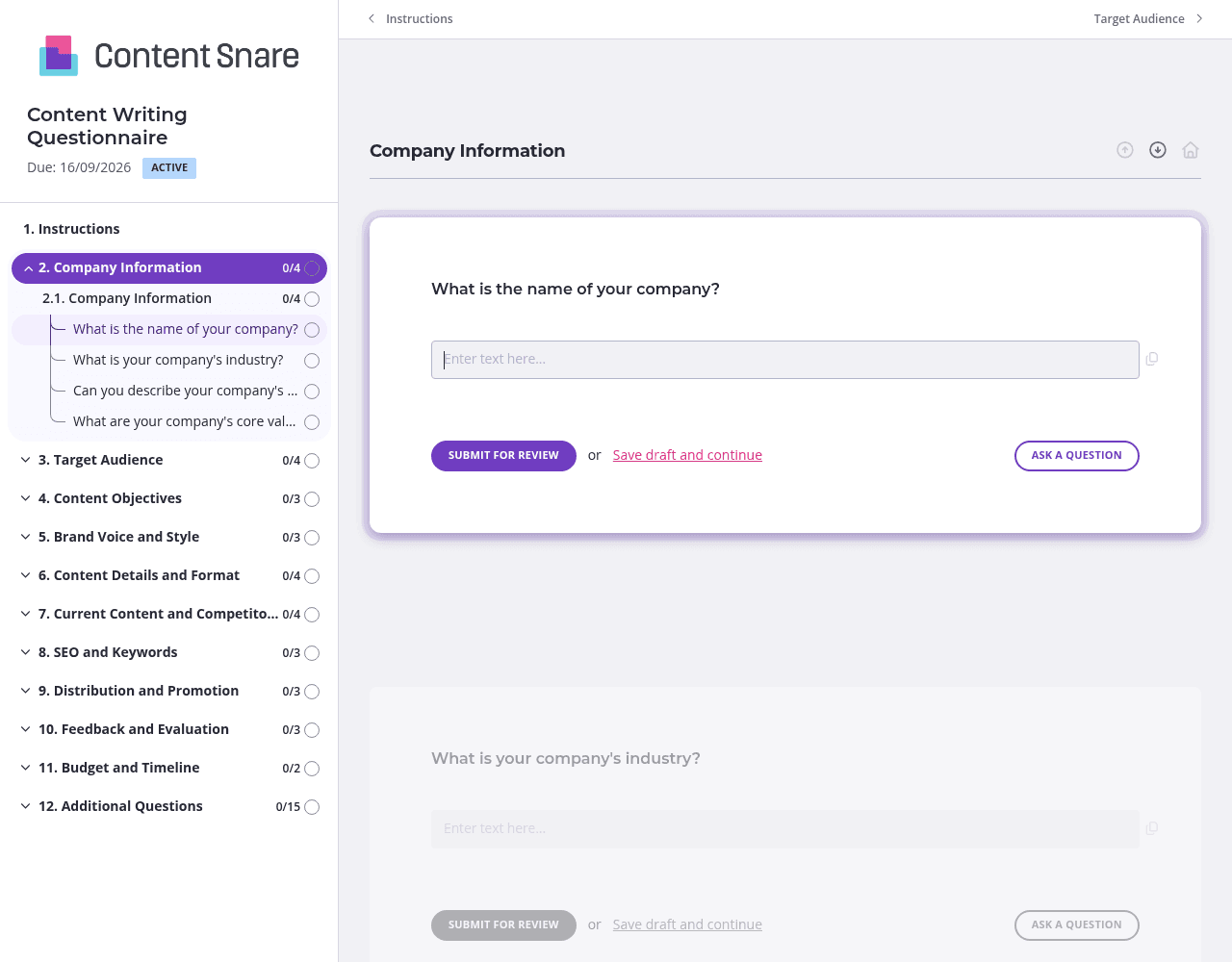
Content writing questionnaires can feel overwhelming when clients see 40+ questions at once. Use pages and sections to group related questions - Company Information on page one, Brand Voice and Style on page two, SEO and Keywords on page three. Clients can focus on one topic at a time, and you'll get more thoughtful answers instead of rushed responses.
The "brand voice and tone" questions trip people up. Most clients say they want "professional but approachable" without realizing that's every company ever. Add a text block with examples: "Conversational like Mailchimp, authoritative like Harvard Business Review, or witty like Innocent Drinks?" Do the same for the competitor content section - upload a screenshot or two to show exactly what kind of examples you're looking for.
You need those competitor examples and SEO keywords before your writer starts, but clients forget. Content Snare sends automatic follow-ups so you're not the one chasing responses. Configure reminders to escalate - a gentle nudge after three days, a more direct one after a week. Your clients get their content delivered on time, and you don't play the bad guy.
Delete or auto-fill the Company Information and Target Audience sections for existing clients. They've already told you their mission statement and core demographics. Show them you remember, save them 10 minutes, and get straight to the project-specific questions that actually matter for this content piece.
Google Forms and email threads don't cut it when you're managing content projects for multiple clients. Content Snare centralizes everything - client responses, file uploads, revision requests - in one place with automatic follow-ups that actually work. You look more professional, clients have a better experience, and nothing falls through the cracks.
Content Snare is trusted by thousands of agencies worldwide and has hundreds of 5-star reviews across G2, Capterra, and Trustpilot. It's ISO 27001 certified, so you can confidently collect sensitive brand guidelines and competitor insights without security concerns.
The platform integrates with tools you already use - your project management software, CRM, and storage systems - so information flows where you need it without manual data entry.
This content writing questionnaire is just one application. Digital agencies also use Content Snare to:
Each form is fully customizable to match your process and branding, so clients experience a seamless extension of your agency - not a generic third-party tool.


