
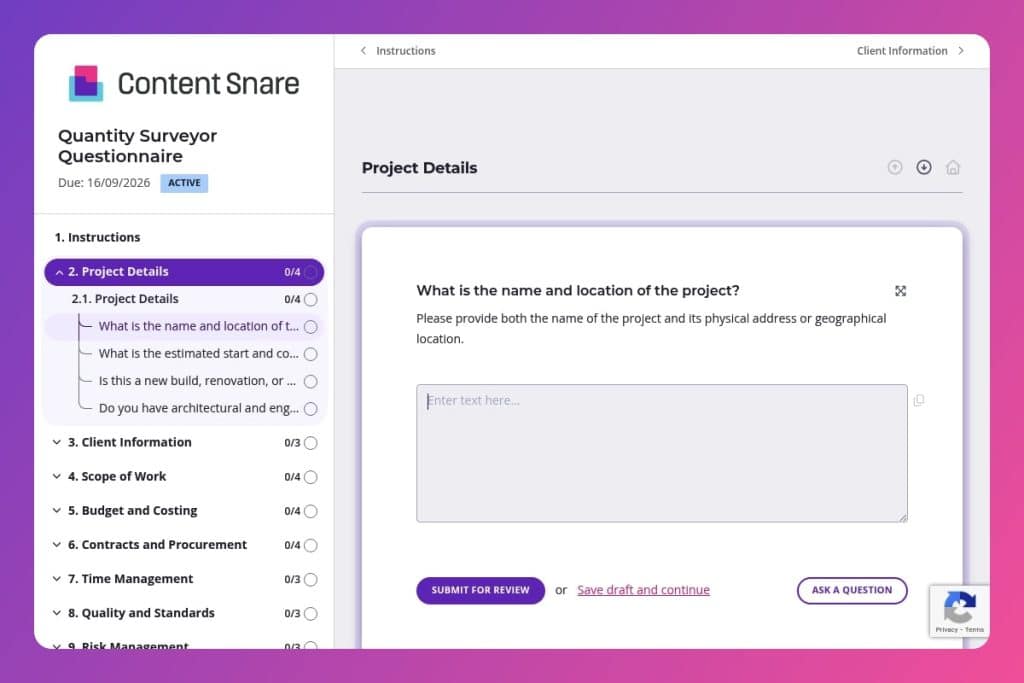


A comprehensive pre-project questionnaire that captures essential details about construction scope, budget parameters, contract preferences, timelines, risk factors, and compliance requirements before cost estimation begins.

Quantity surveyors, cost consultants, and construction estimators who need complete project information from clients, developers, or contractors to produce accurate cost assessments and avoid budget overruns.

Send this form immediately after initial project inquiry and before the first client meeting to gather foundational details that inform your cost estimation, risk assessment, and project feasibility analysis.
Up to 35% of construction budgets get consumed by cost overruns and scope changes. The root cause? Missing information at the start. You can't accurately estimate costs, manage risks, or set realistic timelines when critical project details are scattered across emails, phone calls, and incomplete briefs.
A quantity surveyor questionnaire solves this. It captures everything you need upfront - project scope, budget parameters, contract preferences, regulatory requirements, and risk factors - in one structured form. This post covers what to include in your questionnaire, how to use it effectively with clients and contractors, and a free template you can customize. Let's get started.
Project Details
Capture core project identifiers and baseline documents for estimating and reporting.
Client Information
Identify decision-makers and billing details to streamline approvals, notices, and invoicing.
Scope of Work
Define measurable scope parameters to structure quantification, takeoffs, and allowances.
Budget and Costing
Set budget expectations and reporting preferences to frame cost planning and change control.
Contracts and Procurement
Confirm commercial model and procurement constraints to align pricing strategy and tender timelines.
Time Management
Document schedule drivers to tie pricing, procurement, and reporting to key dates.
Quality and Standards
Record mandatory standards and QA expectations to price compliance and testing accurately.
Risk Management
Surface known risks and contingency strategies to inform allowances and escalation plans.
Communication and Reporting
Align communication channels, cadence, and tools to avoid duplication and gaps.
Legal and Compliance
Note regulatory obligations and approvals that affect scope, sequencing, and cost risk.
Additional Information
Capture edge cases and preferences that influence pricing, logistics, or deliverables.
Send the form before your first meeting: Getting responses in advance transforms your initial conversation. You'll spend less time gathering basic details about square footage, project type, and budget constraints - and more time discussing value engineering opportunities, risk mitigation strategies, and realistic cost expectations. Clients appreciate the efficiency, and you arrive prepared with relevant questions about their specific situation.
Flag incomplete answers early and follow up strategically: Review submissions as soon as they come in, especially sections on scope changes, existing contracts, and regulatory requirements. These areas often get vague responses like "TBD" or "to be confirmed," but they're critical for accurate cost estimation. A quick follow-up call - "I see the procurement process is still being finalized; can we discuss your preferred contract type so I can structure the estimate accordingly?" - prevents costly assumptions later.
Use responses to create your project risk register: Don't let the form sit in your inbox after submission. Pull answers from the Risk Management and Legal & Compliance sections directly into your initial risk assessment document. Known site constraints, pending permits, and budget limitations mentioned in the questionnaire become your first risk items. This saves time and shows clients you're proactive about managing uncertainty from day one.
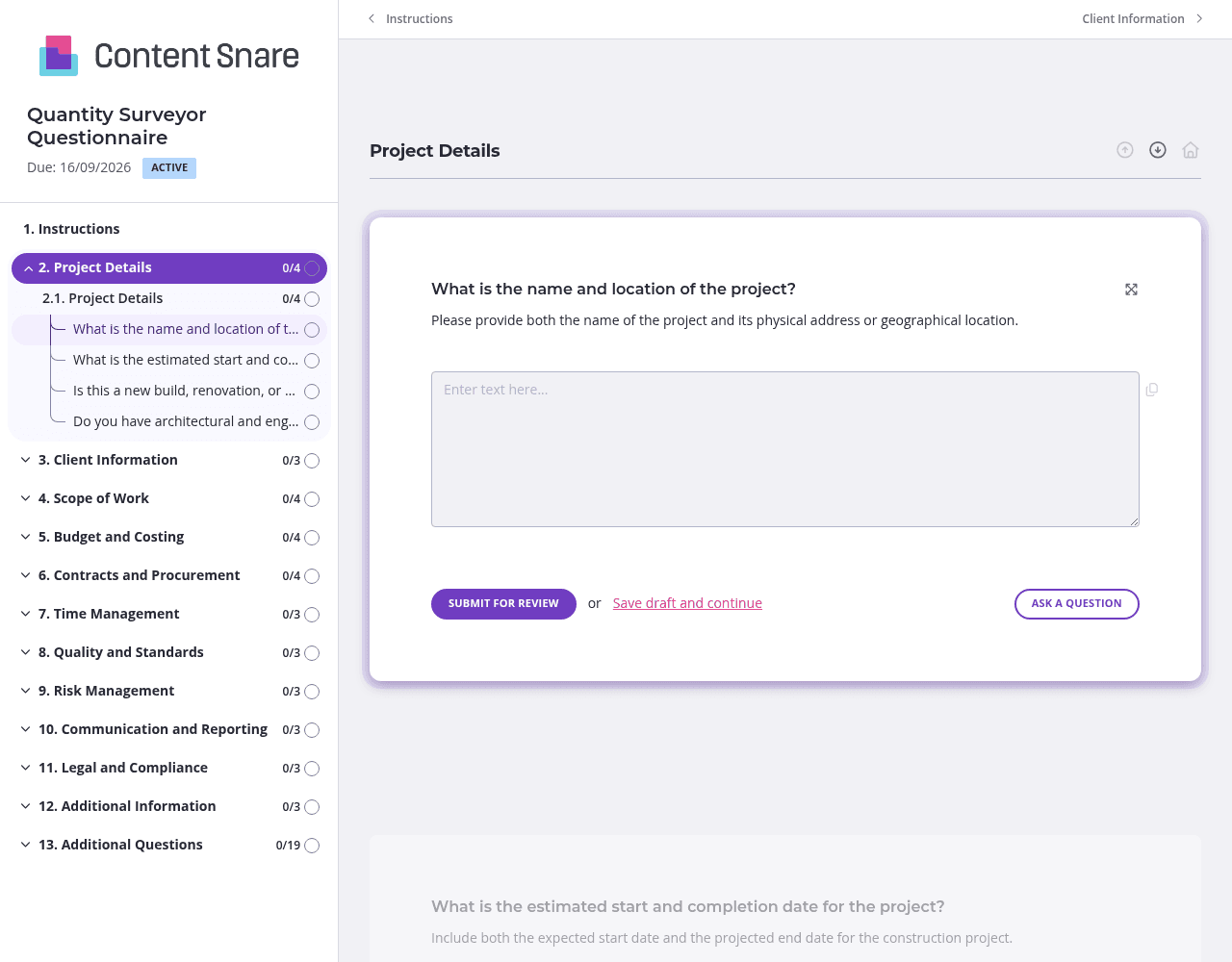
A quantity surveyor questionnaire covers a lot of ground - budget details, contract arrangements, risk factors, compliance requirements. Dumping 50+ questions on one endless page overwhelms clients and increases abandonment rates. Content Snare lets you organize questions into logical pages: Project Details, Scope of Work, Budget & Costing, Contracts & Procurement, and so on. Clients complete one section at a time, save their progress, and return when they have the right information at hand. The result? Higher completion rates and fewer half-finished submissions.
The Budget and Costing section asks whether clients need detailed cost breakdowns or lump-sum figures. Without context, many won't understand the implications of their choice. Content Snare's instruction fields let you add clarifying notes directly above or below questions: "A detailed breakdown takes longer but helps identify cost-saving opportunities. A lump sum is faster if you need a quick feasibility estimate." Same goes for contract types, procurement policies, and quality certifications - areas where a two-sentence explanation prevents back-and-forth emails and ensures accurate responses the first time.
Not every project needs the same level of detail. A straightforward residential new build doesn't require the same risk management questions as a complex industrial expansion with environmental concerns. Conditional logic lets you tailor the questionnaire dynamically. If a client selects "renovation" as the project type, you can automatically show questions about existing conditions and structural assessments. If they indicate no existing contracts are in place, skip the supplier relationship questions entirely. Clients answer only what's relevant, and you get cleaner, more focused information.
Clients often start strong on Project Details and Client Information, then stall when they hit Budget & Costing or Legal & Compliance - sections requiring input from finance teams or legal advisors. Content Snare's automatic reminders handle the follow-up for you. Configure gentle nudges at intervals that make sense (3 days, then weekly), so you're not manually tracking who owes you what. Reminders come from your branded email address, maintaining the professional relationship while ensuring nothing falls through the cracks.
Email threads lose attachments. Shared spreadsheets get overwritten. Phone calls miss critical details. Content Snare gives you a single, organized system for collecting information from clients - with automatic follow-ups, progress tracking, and everything stored securely in one place. No more chasing, no more scattered data, no more starting cost estimates with incomplete information.
Thousands of businesses worldwide trust Content Snare to streamline their client onboarding and data collection. It's ISO 27001 certified, so sensitive project budgets, contract terms, and client information stay protected. The platform integrates seamlessly with tools you already use - your project management software, accounting systems, and CRMs - making it easy to fit into existing workflows without disruption.
Construction professionals use Content Snare for more than quantity surveyor questionnaires. You can collect:
The platform is highly customizable to match your processes, not the other way around. Hundreds of 5-star reviews across G2, Capterra, and Trustpilot highlight how Content Snare improves both efficiency and client experience - you look more professional, clients find it easier to respond, and nothing falls through the cracks.


