
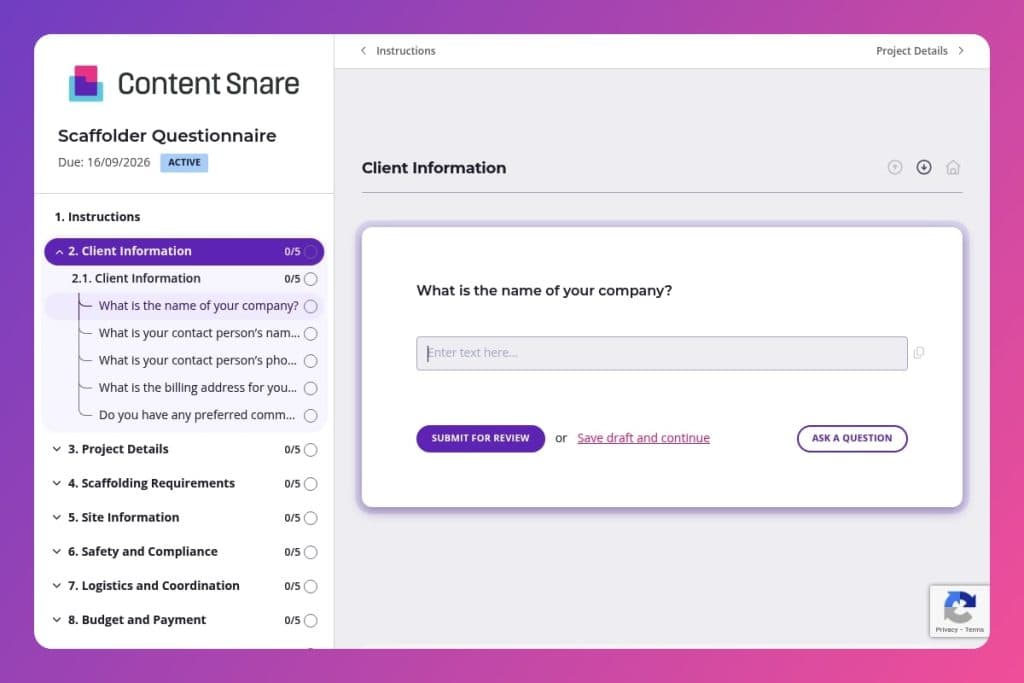


A comprehensive intake form that captures project specifications, site conditions, safety requirements, access restrictions, and logistics for scaffolding services before work begins.

Scaffolding suppliers and contractors who need complete project details from construction clients to quote accurately, prepare the right equipment, and avoid on-site surprises.

Send this form immediately after initial client contact and before conducting site visits or providing quotes, so you arrive prepared and have all critical information documented upfront.
Miscommunication with scaffolding suppliers costs you time and money. A rushed phone call misses critical details about height requirements. An email chain fails to capture ground conditions or access restrictions. Your crew arrives on-site to find the wrong equipment, delayed timelines, and frustrated contractors.
A scaffolder questionnaire eliminates the back-and-forth. This structured form captures everything upfront - project specs, site hazards, safety requirements, and logistics - so nothing slips through the cracks. You'll discover how to use this tool effectively, what questions matter most, and access a free template you can customize. Let's dive in.
Client Information
Capture company details and primary contacts for communication and invoicing.
Project Details
Define scope, site, and programme to baseline resourcing and risk.
Scaffolding Requirements
Specify system, dimensions, coverage, phases, and accessories to inform design, engineering checks, and pricing.
Site Information
Document physical conditions, access, and hazards to validate feasibility and plan controls.
Safety and Compliance
Establish regulatory obligations, inspection cadence, training scope, security, and permit needs.
Logistics and Coordination
Lock in site liaison, delivery windows, storage, parking, and trade interfaces to keep operations moving.
Budget and Payment
Align on budget, terms, cost breakdowns, contract form, and payment schedule.
Additional Services
Offer add-ons that streamline delivery and compliance from design through handover.
Send the form before your site visit: Get responses in advance so you can review project requirements, spot potential issues, and arrive prepared with the right questions. You'll save time on-site and demonstrate professionalism from the start.
Use photos to clarify site conditions: Ask clients to attach images of access points, ground conditions, and overhead hazards when they submit the form. A quick photo of uneven terrain or narrow alleyways tells you more than a paragraph of description ever could.
Flag safety and compliance questions as priority: Make it clear that questions about overhead power lines, permits, and safety regulations aren't optional. These details prevent costly delays and keep everyone safe - emphasize this when introducing the form to clients.
Follow up on vague budget responses: If a client leaves the budget section blank or writes "flexible," don't guess. Schedule a quick call to discuss realistic cost expectations before you quote. It saves you from over-engineering a solution or underpricing your services.
Create a site assessment checklist from their answers: Once you receive the completed form, turn their responses about height requirements, access restrictions, and phasing needs into a structured site visit checklist. You'll cross-reference their information against actual conditions and catch discrepancies early.
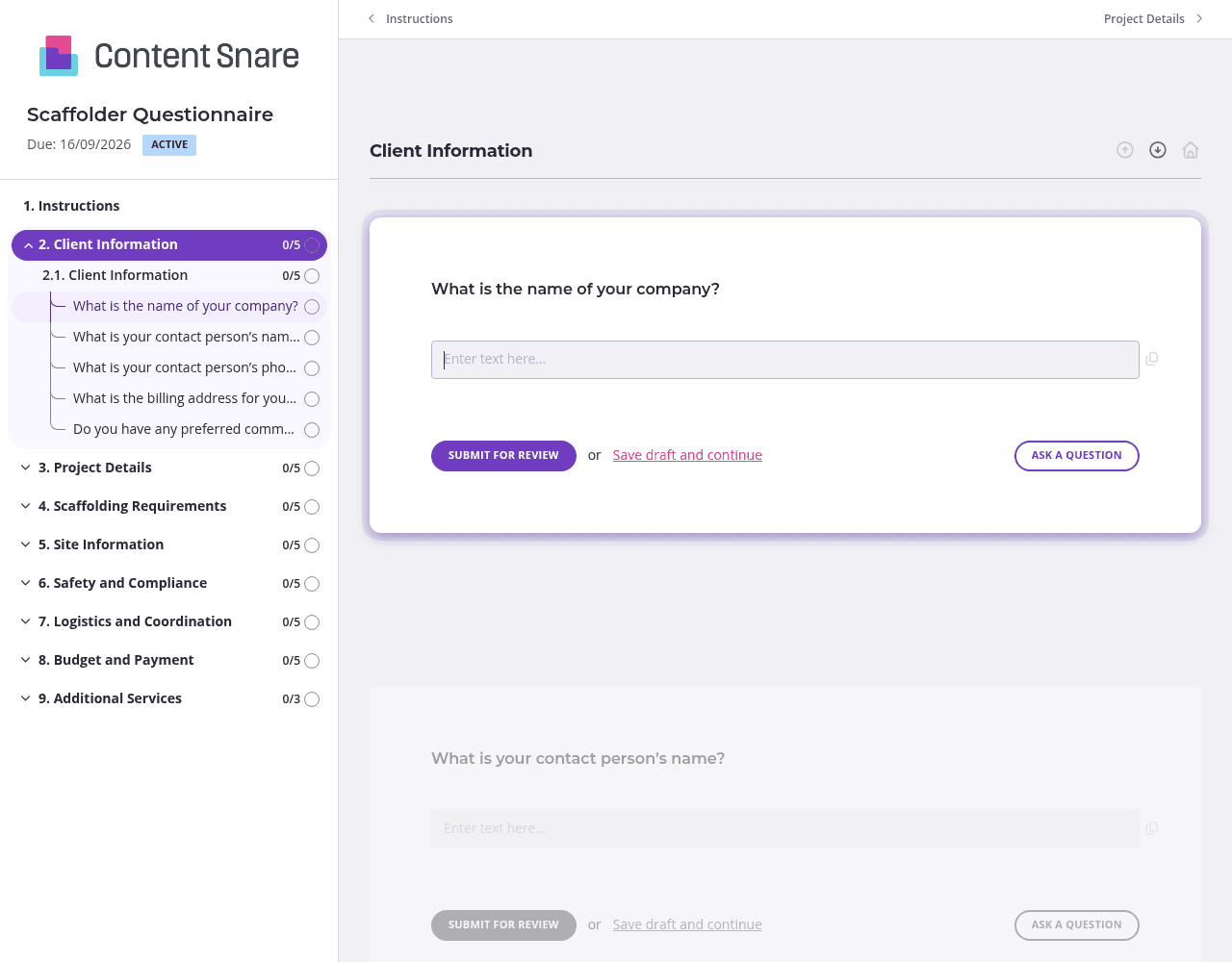
Scaffolding questionnaires cover a lot of ground - client details, site conditions, safety requirements, logistics, and budget. Dump 50 questions on a client at once and they'll abandon the form halfway through.
Content Snare lets you split questions into clear sections like "Project Details," "Site Information," and "Safety and Compliance." Clients tackle one topic at a time, making the process feel manageable. You get complete responses instead of half-finished forms.
Questions about ground conditions or access restrictions sound straightforward to you. To clients? Not always. They might skip critical details or misunderstand what you're asking.
Use Content Snare's instruction fields to add context. Under "What is the current site condition?" explain that you need to know about slopes, soft ground, or existing structures. Add a note about overhead power lines asking for approximate height and distance. Clear instructions mean fewer follow-up calls and accurate information the first time.
Not every project needs suspended scaffolding or multiple phases. Clients shouldn't wade through irrelevant questions.
Set up conditional logic so the form adapts based on their answers. If they select "residential" for project type, skip the industrial-specific safety questions. If they answer "no" to special equipment needs, hide the follow-up about hoists and ladders. Clients see a streamlined form that respects their time.
You've sent the form, but the client hasn't responded. Do you chase them manually? Hope they remember?
Content Snare sends automatic reminders at intervals you choose. Clients get gentle nudges without you playing the bad guy. You stay on top of incomplete responses without cluttering your calendar with follow-up tasks.
Emails get lost. Spreadsheets create version control nightmares. Phone calls miss critical details. Content Snare gives you a dedicated system for collecting client information - organized, tracked, and automated so nothing slips through the cracks. You'll spend less time chasing responses and more time delivering projects on schedule.
Content Snare is trusted by thousands of businesses worldwide and has earned hundreds of 5-star reviews across G2, Capterra, and Trustpilot. It's ISO 27001 certified, so your client data stays secure. The platform integrates seamlessly with tools you already use, and it's highly customizable to match your workflow.
Scaffolder questionnaires are just the beginning. You can use Content Snare to streamline information collection across your entire business:
Every form follows the same automated process - send, track, remind, and organize responses without manual follow-up.


