
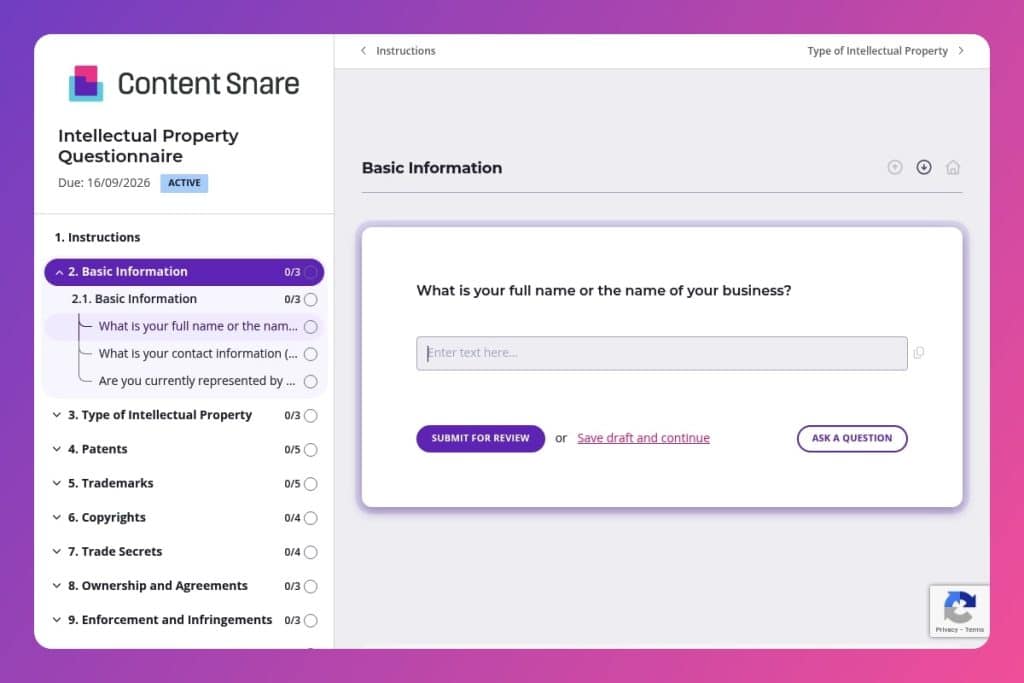


A structured intake form that captures complete patent, trademark, copyright, and trade secret details including ownership, prior disclosures, and infringement history before client consultations.

IP attorneys and law firms who need to gather comprehensive intellectual property information from clients seeking patents, trademarks, copyrights, or trade secret protection without multiple follow-up requests.

Send before initial consultations so clients can compile documents, disclose collaborators and agreements, and provide complete IP details - allowing you to spot filing risks and prepare targeted advice in advance.
Missed a critical filing date because a client forgot to mention prior public disclosure? That single oversight can tank a patent application and cost your firm thousands in rework. Intellectual property intake is riddled with these landmines - co-ownership disputes, incomplete trademark searches, undisclosed infringements - and a single missed detail can derail protection strategies or expose clients to liability.
An intellectual property questionnaire solves this. It systematically captures every patent detail, trademark specification, copyright claim, and trade secret measure upfront - no more chasing clients for missing information or discovering problems mid-filing. This post covers what the form should include, how to customize it for your practice, and a free template to get you started. Let's dive in.
Basic Information
Use these to establish client identity, contact channels, and existing counsel relationships.
Type of Intellectual Property
Confirm the category, capture a concise description, and note development status to route the matter correctly.
Patents
Probe prior art diligence, filing posture, problem statement, supporting materials, and any pre-filing disclosures.
Trademarks
Capture the mark, goods/services scope, first-use dates, clearance work, and international plans.
Copyrights
Clarify work type, creation date, publication status, and originality to assess eligibility and registration timing.
Trade Secrets
Define the confidential asset, its business value, and current secrecy measures and agreements.
Ownership and Agreements
Surface contributors, chain-of-title documents, and any transfers or licenses.
Enforcement and Infringements
Gather current conflicts and intended enforcement approach.
Conclusion
Leave space for edge cases and client concerns that shape scope and priorities.
Send the form before the initial consultation: You'll get better answers when clients have time to gather documents and think through details like prior public disclosures or co-creator agreements. Rushing through these questions during your first meeting leads to incomplete responses and costly follow-up rounds.
Ask clients to attach supporting materials directly in the form: Request patent drawings, trademark logos, copyright samples, or confidentiality agreements as uploads. This eliminates the back-and-forth email chains and gives you a complete picture from day one - especially critical for patent sketches and trademark design files.
Flag the ownership section as non-negotiable: Co-creators and licensing agreements cause more disputes than almost any other issue. Make it clear that clients need to disclose all collaborators and existing agreements upfront. A simple note at the top of that section prevents nasty surprises mid-representation.
Review responses for red flags before your consultation: Scan for issues like public disclosures before patent filing, trademark use without searches, or inadequate trade secret protections. Catching these early lets you prepare targeted advice rather than discovering problems in real-time during meetings.
Use incomplete submissions as teaching moments: When clients skip critical questions - like enforcement plans or infringement history - follow up with a quick explanation of why it matters. This educates them on IP protection fundamentals and builds trust in your expertise.
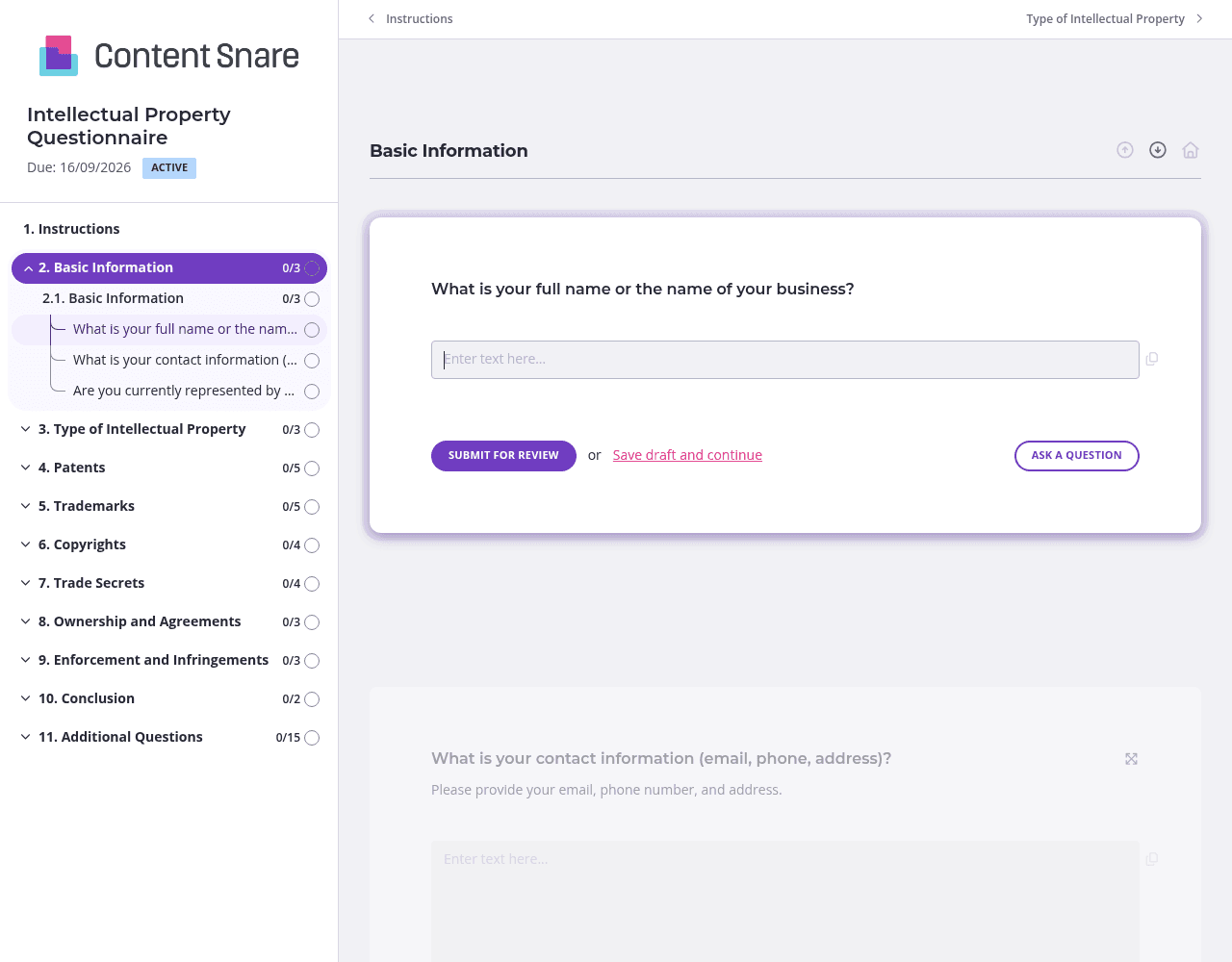
Patents, trademarks, copyrights, and trade secrets each require different information. Split your intellectual property questionnaire into dedicated pages so clients focus on one protection type at a time. This prevents overwhelm and reduces errors - especially helpful when clients are protecting multiple IP types simultaneously.
Not every client needs to answer patent questions if they're filing for trademark protection. Use conditional logic to display relevant sections based on their IP type selection. This keeps the form clean and eliminates confusion about which questions apply to their situation.
Critical questions like "Have you publicly disclosed your invention prior to filing?" can make or break a patent application. Add instruction text explaining why this matters and what counts as public disclosure. The same goes for trademark searches and co-creator agreements - a brief explanation helps clients provide accurate, complete answers the first time.
Clients juggling business operations often start the form but don't finish it. Automatic reminders keep things moving without you having to send awkward follow-up emails. This is especially valuable for IP work where timing matters - patent filing deadlines and trademark availability windows don't wait for slow responses.
Email threads and PDF questionnaires create chaos - attachments get lost, responses arrive incomplete, and you waste hours chasing clients for missing information. Content Snare centralizes everything in one secure place with automatic reminders, file uploads, and progress tracking built in. Your clients get a professional experience, and you avoid the follow-up nightmare.
Content Snare is ISO 27001 certified and trusted by law firms handling sensitive client data. It integrates with tools you already use and has earned hundreds of 5-star reviews across G2, Capterra, and Trustpilot for its ease of use and reliability.
Beyond intellectual property intake, law firms use Content Snare for:
The platform adapts to any information-gathering workflow where you need complete, accurate responses without the back-and-forth.


