
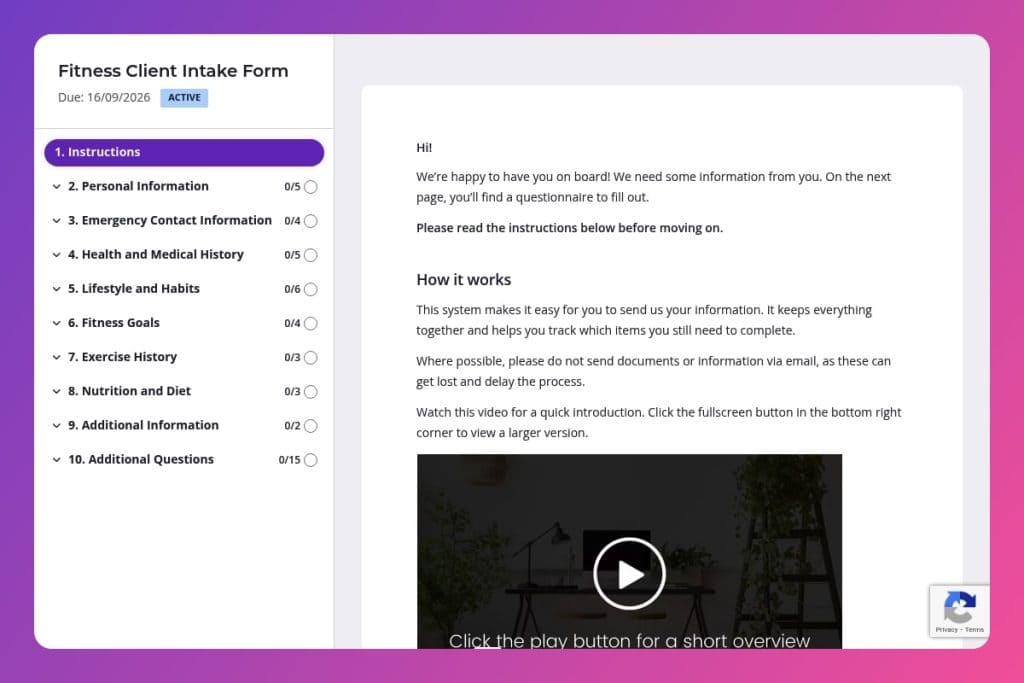


A comprehensive pre-session questionnaire that collects a client's health history, medical conditions, lifestyle habits, fitness goals, exercise preferences, and nutrition information before training begins.

Health coaches and personal trainers who need complete client background information to design safe, personalized fitness programs and avoid medical risks or training mismatches.

Send this form 24-48 hours before the initial consultation so clients can provide detailed responses and you can review medical clearances, flag restrictions, and prepare a tailored program for day one.
Ever wonder why a promising new client ghosts after the first session? You might be missing critical information - past injuries, medication conflicts, or unrealistic expectations - that derail progress before it starts.
A fitness client intake form solves this. It captures health history, lifestyle habits, fitness goals, and exercise preferences upfront, so you can design safe, personalized programs from day one. No awkward mid-session revelations. No wasted time gathering basic details. Just clear information that helps you deliver results faster. This post covers what a fitness client intake form should include, how to use it effectively, and gives you a free template to customize. Let's dive in.
Personal Information
Capture identifiers and preferred contact methods to link records and coordinate scheduling.
Emergency Contact Information
Document emergency contacts to meet duty-of-care requirements and expedite response.
Health and Medical History
Screen for contraindications, risk factors, and necessary modifications before programming.
Lifestyle and Habits
Profile daily load, sleep, and substance use to contextualize recovery and capacity.
Fitness Goals
Define outcomes, timelines, and availability so periodization and logistics match constraints.
Exercise History
Establish training age, modality exposure, and preferences to guide exercise selection and adherence.
Nutrition and Diet
Note dietary patterns and restrictions to align fueling guidance with training demands and safety.
Additional Information
Confirm environment and resources to set realistic programming and progression.
Send it before the first consultation, not during: Give clients 24-48 hours to complete the form before you meet. They'll have time to gather medication lists, think through their goals, and check equipment access without feeling rushed. You'll walk into that first session already knowing their injury history and lifestyle constraints, ready to discuss programming instead of playing catch-up.
Flag medical red flags immediately: As soon as a submission comes in, scan the health and medical history section for conditions that need clearance - uncontrolled hypertension, recent surgeries, or activity restrictions. Reach out quickly if you need a doctor's note or want to discuss modifications. This protects both you and your client, and shows you're taking their safety seriously.
Use their answers to personalize your pitch: Reference specific details from their intake during your first conversation. Mention their stress level when discussing recovery strategies, or acknowledge their evening workout preference when scheduling sessions. It proves you actually read their responses and builds trust fast.
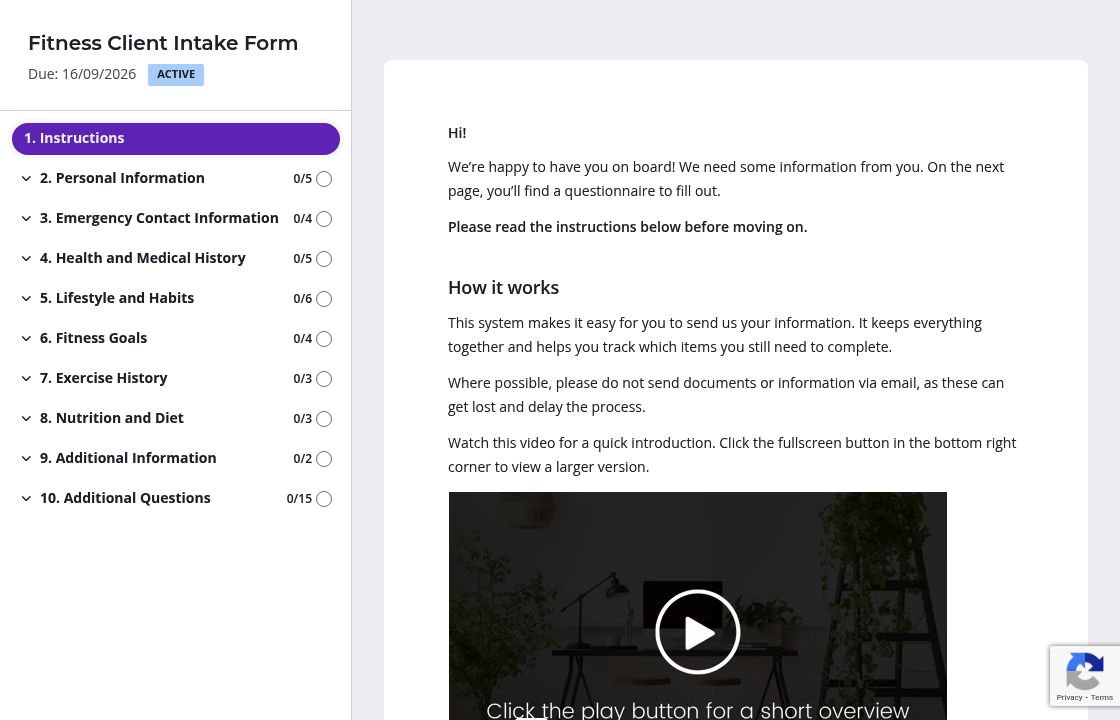
Health history, lifestyle habits, fitness goals, and nutrition questions can overwhelm clients when dumped on a single screen. Split your fitness client intake form into logical pages - one for medical background, another for current habits, a third for goals and preferences. Clients can focus on one topic at a time, and you'll get more thoughtful answers instead of rushed checkbox responses.
Not every question applies to every client. Set up conditional logic so clients only see follow-up questions relevant to their situation. Someone who answers "no" to current medications doesn't need to list them. A client without gym access skips equipment preferences. The form feels shorter and more personalized, which means higher completion rates and less frustration on their end.
The health and medical history section needs clarity. Add brief instructions above those questions explaining what level of detail you need - "Include any chronic conditions like diabetes, high blood pressure, or thyroid issues" works better than a blank text box. Drop a quick note before the fitness goals section reminding clients to be specific: "I want to lose weight" becomes "I want to lose 15 pounds before my wedding in June." Better input from clients means better programming from you.
You've got training sessions to run. You shouldn't spend mental energy tracking who hasn't filled out their intake form yet. Set up automatic reminders that nudge clients at intervals you choose - 3 days, then 7 days, whatever works for your timeline. The system handles the follow-up so you stay the encouraging coach, not the nagging admin.
You could use Google Forms or email back-and-forth to collect client information. But those methods leave you chasing incomplete answers, manually following up, and copying data into spreadsheets. Content Snare is purpose-built for gathering detailed information from clients - it automates reminders, shows completion progress, and keeps everything organized in one place. Thousands of health and fitness professionals trust it because it actually gets forms completed without the admin headache.
Here's what makes it different:
Content Snare has hundreds of 5-star reviews on G2, Capterra, and Trustpilot because it solves the "getting information from clients" problem once and for all.
This fitness client intake form is just the start. Health coaches and personal trainers use Content Snare for weekly check-in forms (progress updates, energy levels, adherence tracking), nutrition logs (meal tracking without endless text threads), goal review questionnaires (quarterly assessments to adjust programming), and liability waivers (collected and stored securely in one place). Any time you need structured information from clients, Content Snare handles it better than email or messaging apps.


