
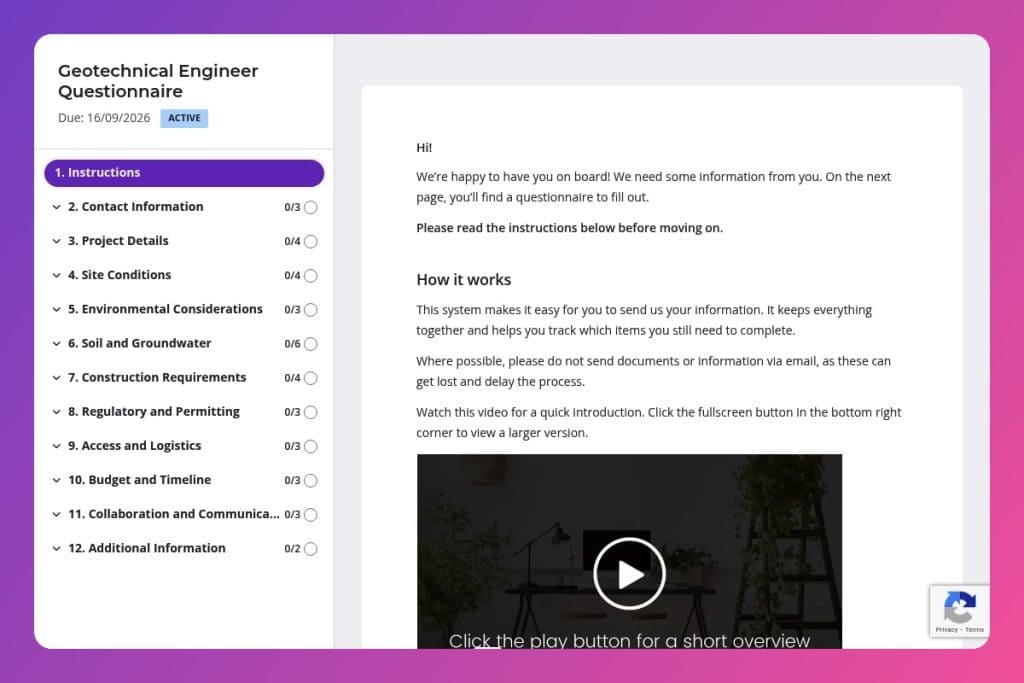


A structured intake form that collects essential project information from clients before geotechnical site investigations, including site conditions, soil data, construction requirements, environmental factors, and access logistics.

Construction project managers, general contractors, developers, and civil engineering firms who need to gather comprehensive site details from clients before commissioning or conducting geotechnical investigations.

Send this questionnaire immediately after project award or during the pre-construction phase, before geotechnical engineers begin site investigations, to ensure all critical information is documented and potential delays are prevented.
You've just won the bid on a major construction project. Then the geotechnical engineer sends back 15 questions about soil conditions, site history, and foundation requirements - half of which your team scrambles to answer. Miscommunication delays the investigation by two weeks, and suddenly your timeline is at risk. This happens more often than it should, and it's entirely preventable.
A geotechnical engineer questionnaire solves this problem by capturing all critical project details upfront - site conditions, construction requirements, environmental factors, and budget constraints - in one organized format. This post walks you through what the form should include, how to use it effectively with your engineering team, and provides a free template you can customize. Let's break it down.
Contact Information
Collect core identifiers to link the submittal to your CRM and project file.
Project Details
Define the investigation scope and initial design envelope.
Site Conditions
Document existing conditions that affect access, equipment selection, exploration layout, and risk.
Environmental Considerations
Flag environmental and utility constraints that affect methods, permitting, and safety.
Soil and Groundwater
Establish subsurface expectations and data gaps to plan exploration depths, sampling, and lab testing. Existing reports reduce uncertainty and may change the scope.
Construction Requirements
Align geotechnical recommendations with structural demand, constructability, and schedule.
Regulatory and Permitting
Confirm compliance drivers and permissions needed before mobilization.
Access and Logistics
Plan mobilization, equipment selection, and site controls.
Budget and Timeline
Set expectations for level of effort, phasing, and deliverable timing.
Collaboration and Communication
Clarify decision-makers and preferred communication cadence.
Additional Information
Capture project-specific constraints or risks not covered above.
Attach existing documentation upfront: Include any previous geotechnical reports, soil test results, or site surveys with the questionnaire when you send it. This gives engineers immediate context and helps them spot data gaps or inconsistencies in the Site Conditions and Soil and Groundwater sections - saving a full round of back-and-forth questions.
Pre-fill what you already know: Before sending the form to clients, complete the Contact Information, Project Details, and Construction Requirements sections with information from your project scope or RFP. Clients will appreciate not having to repeat themselves, and you'll get faster responses on the technical details that actually need their input - like site access constraints or environmental concerns.
Schedule a 15-minute walkthrough call after submission: Once you receive the completed questionnaire, book a quick call to clarify any vague answers in critical areas like foundation systems, load requirements, or site access limitations. Engineers often need to read between the lines, and five minutes of conversation now prevents costly assumptions during the investigation phase.
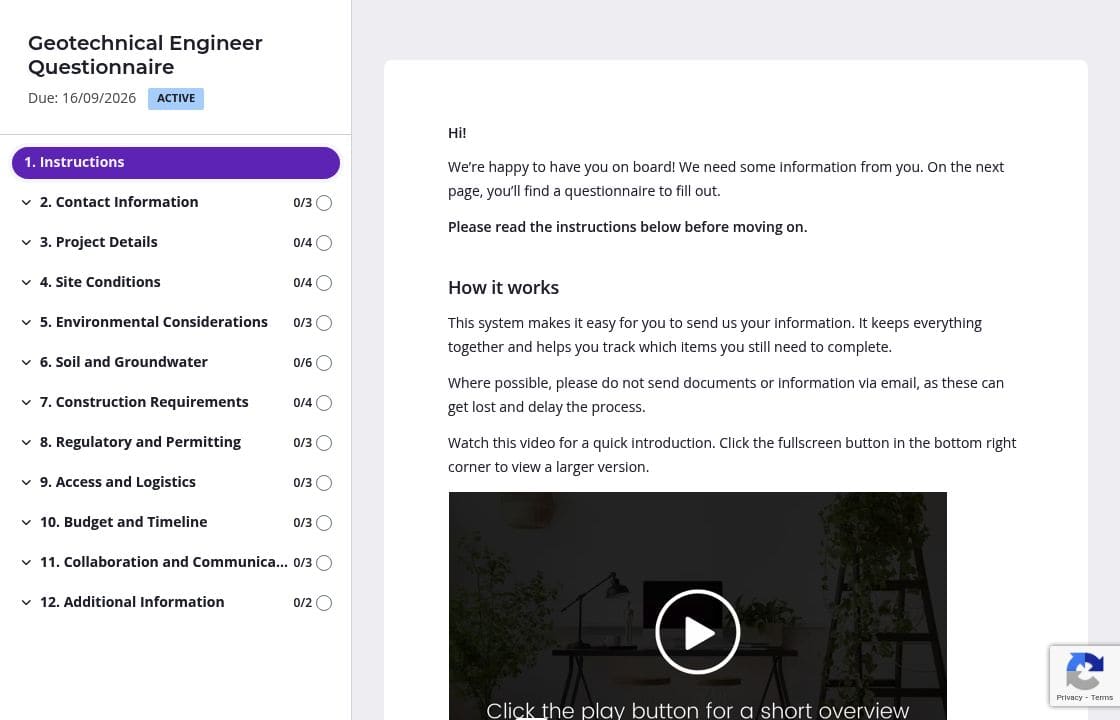
The geotechnical engineer questionnaire covers a lot of ground - from site conditions to regulatory requirements to budget discussions. Content Snare lets you split these into separate pages so clients aren't overwhelmed by a wall of questions. Group related topics together: one page for Project Details and Site Conditions, another for Soil and Groundwater history, and a final page for Budget and Timeline. Clients can save progress and return later, which means you're more likely to get complete, thoughtful responses instead of rushed half-answers.
Questions about foundation systems, load requirements, or soil types often get vague responses because clients aren't sure what level of detail you need. Use Content Snare's instruction fields to clarify exactly what you're looking for. For "What type of foundation systems are being considered?" add a note like "Include any engineering recommendations or constraints from your architect - even preliminary ideas help." For soil history questions, specify whether you need formal reports or general observations. Clear instructions upfront mean fewer revision requests later.
Geotechnical investigations have tight timelines, and waiting on questionnaire responses can derail everything. Content Snare sends automatic reminder emails to clients who haven't completed their forms, so you don't have to chase anyone down manually. You stay in control of the schedule without awkward follow-up conversations, and clients get gentle nudges at intervals you choose. The reminders come from your branded email address, keeping the entire process professional and seamless.
Email threads and Word documents create chaos: questions get missed, attachments disappear, and you waste hours chasing down half-complete responses. Content Snare eliminates that friction with a purpose-built platform for collecting information from clients. You get organized submissions, automatic follow-ups, and a professional experience that reflects well on your business - no manual tracking required.
Content Snare is trusted by thousands of businesses worldwide and has hundreds of 5-star reviews across G2, Capterra, and Trustpilot. It's ISO 27001 certified, so sensitive project data stays secure. The platform integrates with tools you already use and adapts to however you work.
The geotechnical engineer questionnaire is just one application. Construction firms use Content Snare to collect information across their entire project lifecycle:
Content Snare turns information collection from a bottleneck into a streamlined process - so you can focus on building, not chasing paperwork.


