


A comprehensive form that collects site conditions, regulatory requirements, waste management plans, and stakeholder concerns before engaging an environmental consultant for construction projects.

Construction project managers, developers, and site supervisors who need to assess environmental compliance requirements and coordinate with environmental consultants before breaking ground.

Send this before your initial consultant meeting or during early project planning stages to identify permits needed, environmental risks, and community concerns that could delay construction.
Missing a permit deadline can halt your entire construction project. So can overlooking a protected habitat near your site or failing to address community concerns about air quality. Environmental compliance isn't optional - it's the difference between smooth execution and costly delays.
An environmental consultant questionnaire streamlines the assessment process from day one. Instead of scattered emails and missed details, you gather critical information upfront: site history, regulatory requirements, waste management plans, and stakeholder concerns. This post covers what the form includes, how to use it effectively with consultants and regulatory bodies, and gives you a free template to adapt for your projects. Let's dive in.
Project Details
Capture core project parameters so you can scope services, timelines, and team allocation.
Site Characteristics
Establish baseline site conditions that drive surveys, modeling, and mitigation focus.
Regulatory Compliance
Confirm the regulatory context and current approval status to plan pathways and dependencies.
Resource Management
Align sustainability targets with practical controls for materials, water, and energy.
Pollution and Waste Management
Document control measures for emissions, noise, waste, and hazardous materials.
Biodiversity and Habitat
Clarify ecological sensitivities and planned protections.
Stakeholder and Community Engagement
Capture engagement strategy and commitments to manage social license and issues.
Risk Management and Contingency Planning
Identify key environmental risks and the structures in place to manage them.
Monitoring and Reporting
Set expectations for metrics, data flows, and reporting.
Additional Information
Leave space for nuances and certification needs that change scope or sequencing.
Send the form before your first consultant meeting: You'll avoid wasting billable hours on basic fact-finding. The consultant arrives already knowing your site's proximity to water bodies, existing environmental issues, and regulatory landscape - ready to discuss strategy, not gather background information.
Attach previous site assessments and reports directly: If past environmental assessments exist, include them with your submission. Consultants can identify patterns, flag recurring issues, and build on existing data rather than starting from scratch. This saves time and reduces redundant site visits.
Be specific about budget and timeline constraints upfront: Vague answers in the project details section lead to proposals that miss the mark. State your actual environmental management budget and construction phases clearly - consultants can then tailor their scope to what's realistic, not ideal.
Flag community concerns early, even if unofficial: Don't wait for formal complaints. If you've heard local residents mention noise worries or seen environmental groups active nearby, note it in the stakeholder engagement section. Proactive mitigation is cheaper than reactive damage control.
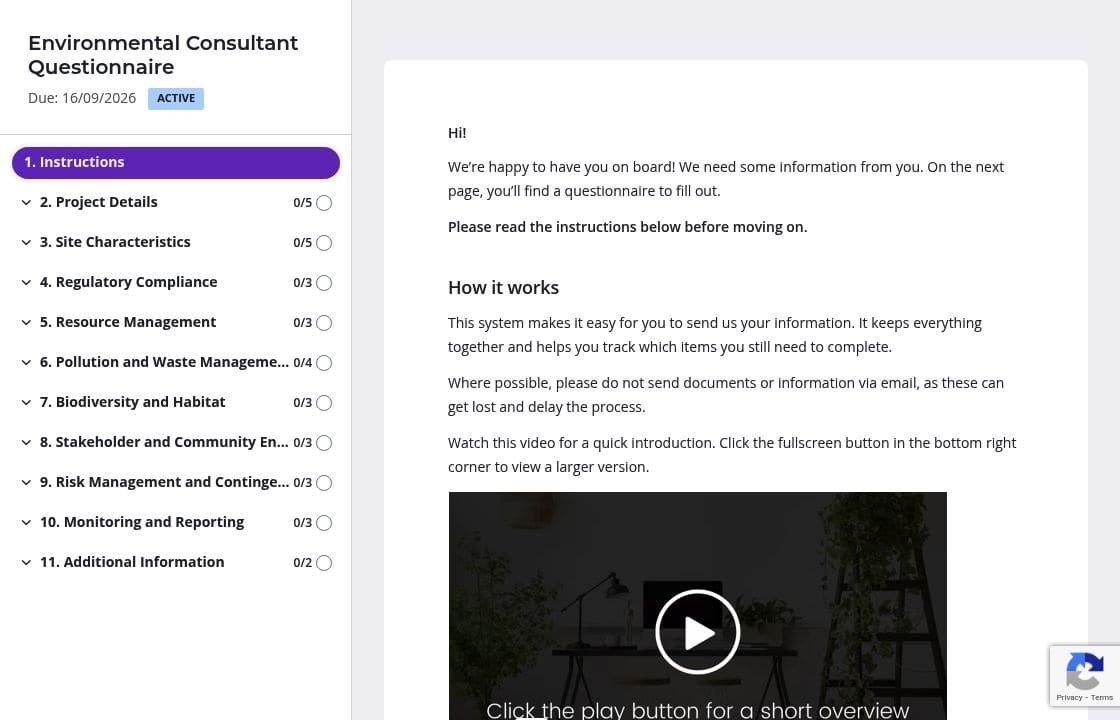
Environmental assessments cover a lot of ground. Structure your questionnaire using pages and sections - one for Site Characteristics, another for Regulatory Compliance, a third for Pollution and Waste Management. Respondents can focus on one topic at a time instead of facing an overwhelming 50-question list.
Questions about biodiversity offsets or environmental management plans often get vague answers from clients unfamiliar with the terminology. Add brief instruction text below these questions explaining what you need: "List any endangered species identified in preliminary surveys" or "Attach your waste management plan PDF if already prepared." Clear guidance upfront means fewer back-and-forth emails clarifying what you actually meant.
You likely have basic project details before sending the form - site address, project scope, timeline. Pre-fill these fields so clients focus on what you don't know: site history, proximity to protected areas, community concerns. This cuts their completion time in half and shows you've done your homework. Delete irrelevant questions entirely for smaller projects that don't need biodiversity strategies or hazardous materials procedures.
Construction professionals juggle site visits, permit deadlines, and subcontractor coordination. They mean to complete your form, then forget. Automatic reminders send gentle follow-ups without you playing enforcer. Schedule them for 3 days, then 7 days after sending - most clients complete the form after the second nudge, and you never touched your keyboard.
Email chains become a nightmare fast. You send 50 questions about environmental compliance. The client answers 32, skips the rest, and buries their response under three other project threads. You follow up. They can't remember what they already sent. You waste hours reconstructing conversations.
On the other hand, Content Snare tracks exactly what's missing. The form shows outstanding questions in real time. Clients see their progress, while you get to see completion status at a glance. No detective work required.
Content Snare also lets you request revisions and additional files without starting over. Clients return to the same form, update specific answers, and you maintain one clean record. Everything stays organized in a single thread.
The platform is ISO 27001 certified and trusted by thousands of businesses worldwide - critical when you're handling sensitive site data and regulatory documentation. It integrates with tools you already use, and you can customize every aspect of the form to match how your firm actually works.
This environmental consultant questionnaire is just one application. Construction firms use Content Snare for:
The platform has hundreds of 5-star reviews across G2, Capterra, and Trustpilot. Construction professionals consistently mention fewer follow-ups, faster project starts, and clients who actually appreciate the organized experience.


