
content snare

Templates

Energy consultant questionnaire template (27 questions)

energy consultant questionnaire

At a glance

WHAT this is

A structured intake form that collects project details, energy systems specifications, certification goals, budget parameters, and stakeholder information before engaging an energy consultant.


WHO this is for

General contractors, project managers, developers, and construction firms planning residential, commercial, or industrial builds that require energy efficiency analysis or green building certifications.


WHEN to use this

During pre-construction or early design phases when selecting an energy consultant, before finalizing HVAC specifications, material selections, or submitting for LEED/BREEAM certification.


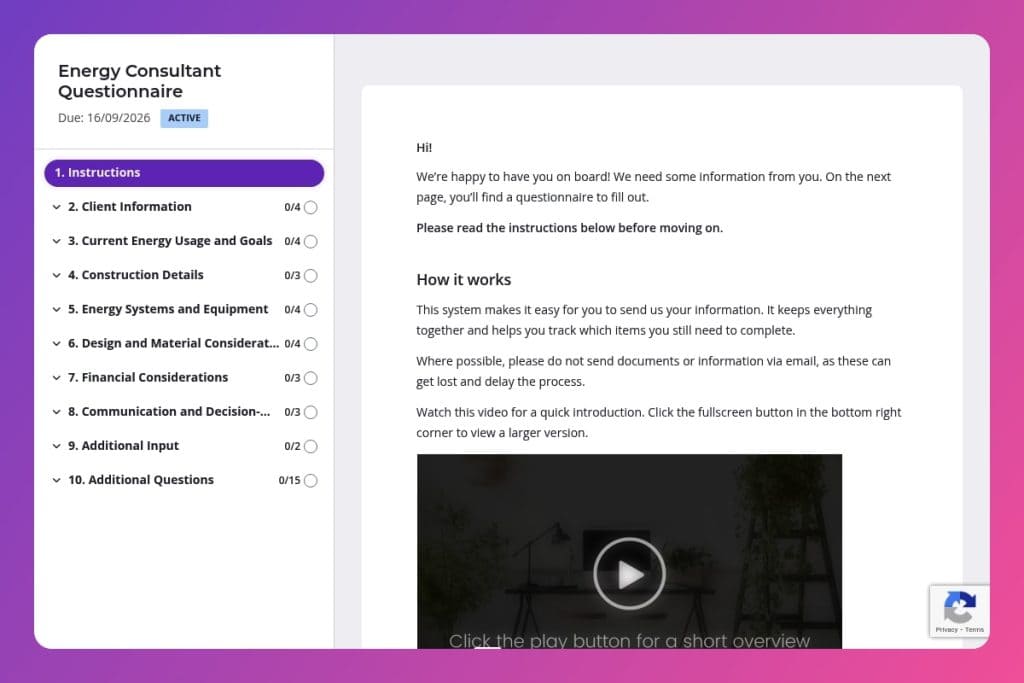
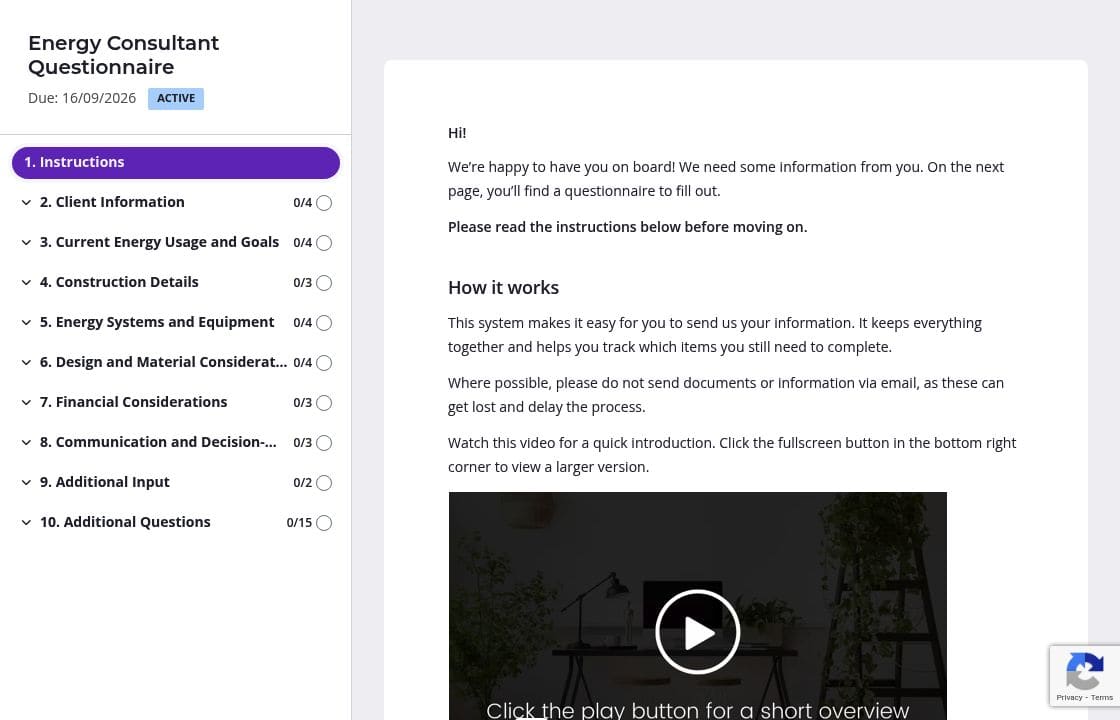
Template preview

Here's what this template looks like in Content Snare.
Start your free trial to send this template minutes.

You're juggling tight deadlines, rising material costs, and sustainability targets that seem impossible to hit. Your team needs expert energy guidance, but coordinating with consultants shouldn't mean endless back-and-forth emails and missed details. Every miscommunication delays your project and inflates your budget.

An energy consultant questionnaire solves this. It captures everything upfront - project timelines, HVAC plans, renewable energy goals, budget constraints, and certification requirements - in one organized form. This post covers what makes an effective questionnaire, how to use it on your construction projects, and includes a free template you can customize. Let's get started.

Tired of chasing people to fill out your forms? Try Content Snare

Content Snare is like a forms tool on steroids. Autosaving forms mean no progress is lost. Automatic reminders mean you can relax knowing your forms will get finished without you having to chase people down. 
Start My Free Trial

Questions to include on your energy consultant questionnaire

Client Information
These fields capture core client and site details and align timelines.

  • What is the name of your company?
  • What is your role within the company?
  • What is the address of the construction site or premises?
  • What is the timeline for the construction project?

Current Energy Usage and Goals
These prompts establish baseline performance and define target outcomes that shape scope and modeling.

  • Do you have any current or previous energy audits available?
  • What is your average energy consumption on site at different project phases?
  • What are your primary goals for energy efficiency in this project?
  • Are there any specific energy certifications you aim to achieve (e.g., LEED, BREEAM)?
    Phase consumption informs model calibration and temporary power planning; certification targets drive documentation, compliance pathways, and measure selection.

Construction Details
These items log project type, scale, and schedule to frame code paths and solution options.

  • What type of construction project is it (residential, commercial, industrial)?
  • What is the total square footage of the project?
  • What are the projected construction start and end dates?

Energy Systems and Equipment
These questions document planned systems and technologies to align modeling assumptions and integration opportunities.

  • Are there specific heating, ventilation, and air conditioning (HVAC) systems being installed?
  • Are you planning to install any form of renewable energy sources (solar panels, wind turbines)?
  • What type of lighting systems will be used (LED, CFL, etc.)?
  • Are you planning to incorporate smart building technologies for energy management?
    System selections drive load profiles, control strategies, interconnection requirements, and commissioning scope.

Design and Material Considerations
These inputs record envelope choices and passive strategies that drive loads, comfort, and compliance.

  • What are the primary construction materials being used?
  • Are there considerations for thermal insulation in the design?
  • Will energy-efficient windows and doors be installed?
  • Are there considerations for passive solar design in the building?
    Envelope and passive measures lock in long-term performance and influence mechanical sizing and daylighting analysis.

Financial Considerations
These questions clarify funding parameters and incentives to prioritize measures and payback.

  • Do you have a budget allocated for implementing energy-efficient solutions?
  • Are there any financial constraints or limits for energy-related changes?
  • Are you aware of any available rebates or incentives for energy-efficient construction in your area?
    Budget and incentives shape cost-benefit ranking, phasing, and eligibility timelines.

Communication and Decision-Making
These fields set decision rights and cadence so recommendations keep moving.

  • Who are the primary decision-makers for energy-related choices in this project?
  • How often would you prefer to receive updates on energy consulting related findings or suggestions?
  • What is your preferred method of communication (email, phone, in-person meetings)?

Additional Input
These prompts surface constraints or context that could shift recommendations.

  • Are there any specific concerns or requirements that need to be addressed for energy efficiency?
  • Is there any other information you wish to provide that may be relevant to your energy efficiency goals?

Other question ideas

When you are creating your energy consultant questionnaire, here are some additional questions you may want to consider. These won't apply in every case, but should give you some ideas as you build out your form.
  1. Are you considering any energy storage systems, such as batteries?
  2. Are there any considerations for water efficiency or wastewater management in the construction design?
  3. Are you integrating any environmentally friendly or sustainable materials in your construction project?
  4. If the construction project is a retrofit, what are the major challenges or issues with the existing energy setup?
  5. Are you interested in adopting any advanced energy monitoring systems?
  6. Do you plan to have any electric vehicle (EV) charging stations installed at the site?
  7. Are you considering any green roof or living wall installations for the project?
  8. Will the building have any specific resilience features to cope with extreme weather conditions or power outages?
  9. How important is it for the project to have a low carbon footprint or be carbon neutral?
  10. Are you interested in any particular renewable energy technologies or approaches that have not been discussed so far?
  11. What is your stand on using smart appliances and systems that can be programmed to run during off-peak hours to save energy costs?
  12. Are there any corporate social responsibility (CSR) targets or commitments that this building project needs to align with?
  13. Do you have plans to facilitate cycling or other green commuting options for occupants of the building?
  14. How open are you to concepts like natural ventilation or day-lighting as part of your energy optimization strategy?
  15. Are there any particular indoor environmental quality standards that need to be met, such as air quality or noise levels?

Tips to get the best results

  • Gather baseline data before you send the form: Pull together any existing energy audits, utility bills, or past project reports you already have. This preps your consultant to ask smarter follow-up questions and saves you from multiple rounds of clarification later.

  • Be specific about your certification goals upfront: If you're targeting LEED, BREEAM, or other standards, mention it clearly in the "Current Energy Usage and Goals" section. Your consultant can tailor recommendations to meet those exact requirements from day one, rather than retrofitting advice later when it's costly to pivot.

  • Include your subcontractors in the decision-maker section: Energy decisions touch HVAC installers, electricians, and architects - not just the project manager. List everyone who needs to sign off so your consultant knows who to loop in and you avoid bottlenecks during implementation.

  • Attach architectural drawings or material specs when you submit: The more context you provide about insulation types, window ratings, or passive solar design considerations, the more accurate your consultant's assessment will be. A few extra attachments now mean fewer site visits and faster turnaround.
How to use Content Snare for your energy consultant questionnaire

Use conditional logic to show only relevant questions

Not every construction project needs the same level of detail. A small residential build doesn't require the same energy systems discussion as a commercial high-rise. Set up conditional logic so questions about industrial HVAC systems or large-scale renewable installations only appear when clients select "commercial" or "industrial" project types. Your clients see a cleaner form, and you get answers that actually matter to their specific situation.

Add instructions to the financial and certification sections

Energy budgets and LEED requirements confuse clients who aren't familiar with the terminology. Drop in brief instructions above those question groups - explain what counts as "energy-efficient solutions" in your budget question, or link to a quick explainer about BREEAM vs LEED certifications. Clients answer correctly the first time, and you avoid the awkward follow-up asking them to clarify what they meant.

Pre-fill project details you already know

You've likely discussed basic project information - company name, site address, construction type - before sending this questionnaire. Pre-fill those fields so clients can focus on the complex stuff: energy consumption data, renewable energy plans, and material specifications. It shows you're paying attention and cuts their completion time in half.

Set up automatic reminders for busy project managers

Construction timelines don't wait for late questionnaire responses. Automatic reminders nudge clients without you having to send "just checking in" emails that make everyone uncomfortable. Schedule them at reasonable intervals - say, 3 days and 7 days after sending - so you get the information you need without playing the bad guy.


Why use Content Snare

Content Snare keeps everything organized in one place. Clients see exactly what you need, and you see exactly what's missing. Automatic reminders handle follow-ups so you don't have to chase busy project managers during critical construction phases.

The platform is ISO 27001 certified, which matters when you're collecting sensitive project budgets, site addresses, and proprietary energy audit data. Thousands of businesses trust it for client information collection, and it has hundreds of 5-star reviews across G2, Capterra, and Trustpilot.

Content Snare integrates with your project management software, CRM, and cloud storage. Completed questionnaires flow directly into your workflow instead of sitting in your inbox waiting to be manually transferred.

The platform is highly customizable too. Adjust questions for different project types, add your company branding, and include visual instructions that help clients understand complex energy certification requirements.

Other ways to use Content Snare in construction

This energy consultant questionnaire is just one application. Construction professionals use Content Snare for:

  • Pre-construction client intake forms to gather project scope, budgets, and timeline expectations before the first meeting
  • Subcontractor onboarding questionnaires to collect insurance certificates, licensing information, and safety certifications
  • Site inspection checklists where field teams can upload photos, document issues, and record progress against milestones
  • Material and equipment specification forms to confirm supplier details, delivery schedules, and technical requirements
  • Change order request forms that capture scope changes, cost impacts, and client approvals in one organized submission
  • Project closeout documentation to collect warranties, maintenance schedules, and final sign-offs from all stakeholders

The same benefits apply across every use case: less back-and-forth, better organization, and a more professional client experience.


Get the information you need without chasing people

Content Snare is the stress-free way to get information from anyone. Break free of your inbox and reclaim your time. Let Content Snare chase your clients for you.
Start My Free Trial

Related templates

lockcrossmenuchevron-uparrow-right